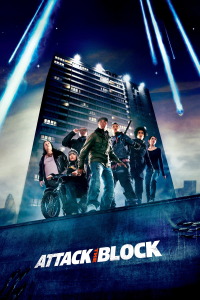
Review of Attack the Block (2011) by Shiira — 20 Sep 2011
"I hate those f****** things," Eileen complains, in "Wonderland", after some black youths set off firecrackers, stopping short of amending that declaration with a noun change, since her present company, a neighbor, likewise black, wouldn't sympathize with the Englishwoman's dismay toward the racial diversity in this working-class neighborhood.
The aging wife and mother barely looks at her walking companion, so eager to befriend this lonely lady, who in return, ungenerously, wishes she had somebody white to confide in, with regard to all the riff-raff invading the U.
K., like the Brazilian man next-door, whose yapping dog this racist woman ultimately poisons. At her age, Eileen believes that she should be living among her own kind; a Portuguese-speaking free zone, not to mention, an African-accented English one, too.
Paying a visit to her daughter's gentrified flat, the mother bristles noticeably at the sight of Molly's remodeled kitchen, the verification she deems as proof that Bill, Eileen's browbeaten husband, has let her down as a provider.
Later in the film, after locking himself out, Bill returns home belatedly, by which the camera points at the spent wife, staring forlornly out from the window of her standard-issue kitchen, suffering the indignity of a white woman doing time in a ghetto.
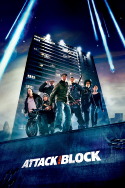
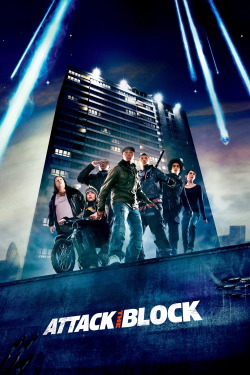
Sam knows the feeling, when in "Attack the Block", the nurse gets mugged at knife point by some pubescent hooligans, primarily black, whose ringleader Moses, the switchblade holder, appears ready to stab the hesitating woman, so slow in giving up her ring.
"Pardon my French," an Eileen-like neighbor gripes to Sam, "but they're f***** monsters," back at the council estate(housing project), where among themselves, "native" Londoners can speak freely about minorities, the scapegoats for their sad lives.
When the police arrive at the apartment to take down Sam's statement, the aggrieved woman describes her attackers in the vaguest terms, describing only their articles of clothing, stopping short of identifying them by race, as if to prove she's not a bigot like any other disgruntled white Londoner, starting with her badged interviewer, who, quite pointedly, never asks for the perpetrators' skin color.
By leaving out this crucial piece of information that any competent enforcer of the law would ask, "Attack the Block" makes the moviegoer complicit with both Sam and the cop in assuming that Moses and his gang were black.
She never finds out if the gang was capable of senseless violence and sexual degeneracy, since the alien smashes into a parked car, allowing the nurse to escape. These boys aren't Elliott, their genre predecessor; these boys presume the creature, in the Spielbergian sense, to be more "War of the Worlds" than "E.
T.", an unfriendly. With its rows of razor-sharp teeth and slimy skin, the alien sure has the look of a killing machine, but the adventitious snarler doesn't attack, it retreats, an indication that the visitor may be non-violent, and afraid for its life.
Chasing the creature down on bikes, "Attack the Block" turns parodic, a neoteric urbanization of Spielberg's wonderland, now replaced by the inner-city, where the creature gets slain in a structure, similar to the shed that Elliott first discovers his heart-lighted friend.
"Attack the Block" is not the first film to recast the 1982 classic with a downtown setting. In "The Brother from Another Planet", a black alien crash-lands his spaceship in New York, and soon learns that his skin color is an impediment on our green planet.
The men in black who pursue him are bounty hunters, whose mission is to recapture runaway slaves. At a black history exhibit, the "brother" learns about the horrible irony forthrightly, as he studies the imagery of the on the museum walls, and realizes the mistake he made in leaving home for a place that's only marginally better.
Disguised as a mere actioneer, "Attack the Block", in actuality, plays like a feminist version of the Sayles film. Under uv rays in a roomful of marijuana plants, Brewis figures out that the blood on Moses' jacket contains a pheromone, meaning that the alien the gang leader killed was a girl, and furthermore, the next wave of ET's function in the same capacity as the black-clad men who were after the "Negro".
The gang does their dirty work; in essence, killing an organism who escaped a patriarchal planet, only to have the bad luck of landing in an ideologically-similar terrene. Because the marauding invaders are blind, they can't see that the black youths are comrades, in which the female alien's fate could have been Sam's fate, had it not been for that initial third encounter.
The sister from another planet, by sheer happenstance, becomes a martyr for all womankind. The film seems wholly unaware that the circumstantial heroes are, potentially, cold-blooded killers.
This review of Attack the Block (2011) was written by Shiira on 20 Sep 2011.
Attack the Block has generally received positive reviews.
Was this review helpful?