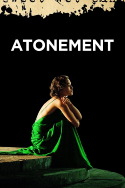
Review of Atonement (2007) by Cameron J — 04 Sep 2014
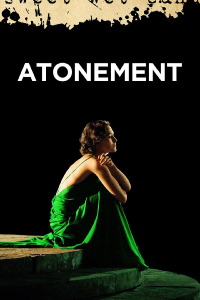
"Joe Wright's A Series of Unfortunate Events"! Wait, so, a film whose title features a term commonly associated with religious redemption isn't the feel-good flick of the year? Shoot, this isn't too far away from being just that, because 2007 was pretty much the year for downers, particularly period piece downers. Actually, I don't know if this is much of a period piece this is, relatively speaking, that is, because by being set during WWII, it's practically futuristic sci-fi for Joe Wright and screenwriter Christopher Hampton. Watching a film directed by the dude who did 2005's "Pride & Prejudice", and written by the guy who is best remembered for "Dangerous Liaisons", I can feel myself getting older, with my light southern accent turning into a thick British one, which is exactly what Kiera Knightley is going for, I'm sure, because as an actress of questionable ability who is trying so hard to get some credibility under the loose belt around her non-waist, she needs to "atone" for the other 2007 period drama she did. Okay, fine, I'm that guy who liked "Pirates of the Caribbean: At World's End", but then again, I'm also that guy who thought that James McAvoy struck again after this film when he took a break from all of the weighty period dramas for "Wanted". Still, make no mistake, this film goes to show you just how good a taste McAvoy has in movies, because this stuff is almost as seriously rewarding as it is seriously British, which isn't to say that its familiarity ends there.
For all of its stylistic freshness, if not a particularly firm dramatic bite, when this film falls into trappings as a period melodrama in its vein, it falls pretty hard, with familiar characters and conflicts along a formulaic path that gets to be about as predictable as it does calculated. As powerful as the most genuine dramatic elements of this film are, it probably shouldn't have to resort to histrionics, and sure enough, the film is rarely all that melodramatic, yet not everything clicks as totally believable, with most of the manufacturing being, not in the scripting, but in the directorial storytelling. Joe Wright can get a little carried away at times, whether it be with a style that, no matter how remarkable, limits a degree of depth to substance, or with his dramatic atmospherics whose theatrical kick does away with subtlety, particularly when the writing does succumb to its own dramatic subtlety issues. Really, a much, much bigger issue with the telling of this drama is inconsistency, for although an episodic structure is clearly intentional, when this film shifts from a melodrama driven by terrible misunderstandings, to a war drama, then to a tale of redemption, it jars something fierce, incoherent with its thematic value, and uneven in its exploration of each individual character, until a sense of progression to ultimately predictable outcomes is lost in the unbalanced plotting which derives from excessiveness. The excessiveness stands to be more extreme in this epic of only two hours, in spite of all of the glaring focal inconsistencies, but too much goes on in this overblown opus, and a lot of it is too much of nothing, leading to a meandering that is made all the more limp by times in which Joe Wright loses realization with his more subtle dramatic storytelling, and finds himself meditating on the dragging which begets a dullness that makes all of the other shortcomings all the more noticeable. There's a lot worthy of praise here, and the final product rewards consistently with its strengths, which go into making some powerful glimpses into a stronger drama that is not found on the whole with this affair, whose familiarity, melodramatics, unevenness and perhaps overly subdued pacing hold the final product back. Still, the film isn't held too far back, for it is an ultimately rewarding film which fulfills pretty firmly with both substance and style.
With this film's artistic attributes, subtle proficiencies go a long way, as is the case with, say, a score by Dario Marianelli that, for each formulaic element, gets to be creative in its mixing experimental sounds into beautiful, light modern classical pieces which, upon being brought to the utmost prominence, in all of its soaring grace, helps in defining the heart of this beautiful film. A lot is also defined by the visuals of the film, whose dynamic settings which include upper-class English property, war-torn Europe, and other environments along this line in the 1940s are brought to life by Ian Bailie's, Nick Gottschalk's and Niall Moroney's lavishly immersive art direction, made all the more captivating by cinematography by Seamus McGarvey that is crisply well-defined, with a haunting emphasis on lighting during the dreamier, lighter sequences, and handsomely bleak emphasis on grit during the heavier sequences. The film is so gorgeous that it's sometimes difficult to describe with relative ease, and that can be said about the visual and musical styles which make the final product an aesthetic triumph so sound that it helps in breathing life into a story concept that is worthy of a tasteful approach, for although it has its tropes and histrionics, and is uneven in its episodic structure, it is weighty in its associating a story of budding love's being threatened by horrible accusations of sexual deviancy with themes regarding the dark depths of one's imagination in a case of misunderstanding; a story of entrapment in a battlefield with themes regarding how war can scar someone and distance loved ones; and a story of seeking redemption for dreadful mistakes with themes regarding how much coming of age can thrive on witnessing true horrors faced by good people, all of which carry consistent themes regarding honesty, and a dramatic challenge for any writer. Draggy, uneven and thin in a number of other ways, with conventions and subtlety issues, Christopher Hampton's script, whether it be making missteps on purpose or not, is misguided as an instrumental factor in the challenging of the final product's strength, but its highlights have their role in the engagement value of the drama, delivering on witty dialogue that reflects sophistication with more consistency than a nonlinear structure that has its respectably unique aspects to color up generally steady story structuring that, when realized, draws a nuanced narrative, carried by nuanced characters and character portrayals within a cast full of talents, from which emerges such standouts as all those portraying the role of Briony Tallis, - initially portrayed as an ambitious, but vulnerable, fearing and misguided little girl by the show-stealing, Oscar-nominated Saoirse Ronan, then as a caring young lady seeking redemption for her mistakes by Romola Garai, and finally as a guilty woman nearing the end of an incomplete life by Vanessa Redgrave - as well as leading man James McAvoy, whose revelatory dramatic abilities prove to be one of the sweetest treats throughout this affair. A well-educated and good-hearted, but humble young man whose integrity and life are decimated by false accusations that lead him into war which will further shake his faith and violate his innocence, Robbie Turner is a particularly challenging role which McAvoy brings to life with his usual grounded charisma, and gradual expansion of subtle, piercing dramatic layers, thus, most all segments directly focusing on Turner are arguably the most compelling in this film, but it's not as though the film is ever less than compelling, thanks to its sound style and substance, and how they are both orchestrated by Joe Wright. Wright, as director, at least has style on his side, taking advantage of Paul Tothill's cracklingly snappy editing to tightly orchestrate the flashier score work and more playful scene structuring in a nifty, slickly paced manner, until coming to more meditative moments of stylization that use extensive and immersive tracking shots to draw you into memorably environmental sequences, - namely the captivating five-minute-long shot exploring a recreation of the devastating aftermath of the Battle of Dunkirk - although that isn't to say that Wright's skills peak with the aesthetic attributes, because questionable pacing and a tendency to lose substance in style - at least in an overly theatrical, perhaps unsubtle fashion - betray much of the final product's impact, when Wright's marriage of thoughtful sobriety and rich artistic taste is realized, the result is anything from a certain engrossing dramatic tension, to powerfully moving impact. I wish that the highlights in engagement value matched the whole of the film, which is consistently compelling, but could have flirted with excellence if it wasn't for the problematic attributes to storytelling that still don't stand a chance of obscuring the considerable strengths which make the final product thoroughly rewarding.
When it's all said and done, the film isn't consistently unique, nor is it consistently genuine with its melodramatic writing and theatrical, somewhat overstylized storytelling, but focal inconsistencies throughout an overdrawn and often dryly told course ultimately render the final product unable to stand out, in spite of the breathtaking scoring, immersive art direction, captivating cinematography, and worthy subject matter, brought to life to some extent by the smart writing, powerful performances and inspired direction which secure Joe Wright's "Atonement" as an engrossing and sometimes devastating portrait on the consequences of truth and lies.
3/5 - Good.
This review of Atonement (2007) was written by Cameron J on 04 Sep 2014.
Atonement has generally received very positive reviews.
Was this review helpful?