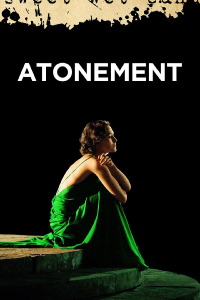
Review of Atonement (2007) by Diego T — 24 Apr 2014
Well... after writing this review, I may have to start giving some merit to those who call me "pretentious." Seriously though, Atonement is a great film, and has the potential to join Casablanca and Gone With the Wind in the lexicon of incredible screen romances. This is the kind of movie that boasts great performances, marvelous direction, a fantastic script, and possibly the best cinematography of the 21st century... but is for some reason instantly forgettable. It's probably because a good amount of the film is padding, or perhaps because it moves slower than molasses in January. Still, although this movie is glacially paced, it's almost never boring, which really speaks a lot for the quality of the filmmaking. I was paying rapt attention to Atonement from beginning to end, something I cannot say for other "modern masterpieces" such as Requiem for a Dream, Gravity, or Adaptation. If nothing else, this is a film that lives more or less up to its hype.
Atonement stars Kiera Knightley and James McAvoy as two lovers in the summer of 1935, just before war turns Europe upside-down. Okay, we all know the story: She's a privileged young upper-class woman and he's a slightly less privileged housekeeper's son at her grandiose mansion. And when I say "grandiose," I mean every syllable... like, damn. I never thought I'd see a house that puts Downton Abbey to shame. This kicks off a whole slew of great cinematography in the film, but I'll get to that later: The pair are unable to spend much time together, as right in the evening when they finally, er, go at it, a man staying in their home (Eggs Benedict Cummerbund) sexually assaults a young girl. Not understanding the situation, and already scarred from seeing Knightley and McAvoy bang in her living room, Knightley's little sister Briony (Saoirse Ronan) tells the police that McAvoy did the raping.
This sets off a long, long chain of events that sends McAvoy off into the army and Knightley into a five-year-long funk. This is the good hour or so of the film that is less than action-packed, but it's still one of the better parts of the movie, mainly due to the cinematography. There is a whole lot to love about the visuals in this film from beginning to end, but this is where the cinematography really begins to run wild. From minute one of McAvoy's experience at war, we know that we're not in for our average two-hour love and war story. There are shots of beautiful colors and foliage interspersed with the dead bodies of children. There are brief, throwaway moments that you can tell the director lovingly put into the film, such as the reflection of the planes traveling overhead in the puddles. And, of course, there's the thing this film is most famous for: That long-ass tracking shot across the beaches of France. McAvoy walks through a literal army of people, passing things that will give you hope for humanity and things that will instantly snuff it out. And it's all in five or six awesome minutes of uncut, decadent glory. I don't want to go all cinema nerd here, but man... what an awesome scene.
And then, after this buildup of tense, powerful beauty, we have the ending. I don't want to spoil this, but it is heartbreaking. After being given so much hope, it's all extinguished in an emotionally wrenching finale that I admit I should have seen coming, but didn't (shoulda read the book). One minor quibble would be that it's a serious cop-out when a historical film fast-forwards half a dozen decades to present times, just to show one of the characters old and wizened, looking back on their lives (cough cough, Saving Private Ryan, Little Big Man, cough cough), as it devalues the entire experience the audience just went through. Ending a film by saying it was all a flashback is nearly as bad as having it turn out to all have been a dream. It also completely destroys the visual splendor that the cinematographers were shooting (no pun intended) for in this film by zapping us from a beautiful 1940s setting to a dull recording studio in present day. Still, a film this strong overall deserves to get some leeway, and I'd be lying if I said I was complaining about that at the time.
Final Score for Atonement: 8/10 stars. I know, I know. Oooh, look at the pretentious film buff, he liked the depressing romance movie with the good cinematography. Whatever. Let the naysayers naysay. This movie is powerful and emotional stuff, and will resonate deeply with anyone who has ever wondered what life would have been like if they hadn't made one silly mistake... which, if I'm not mistaken, is just about everyone. The film strikes deep into the core concepts of, well, atonement, and forces the audience to somehow bring themselves to forgive a character so appallingly naïve that we hated her even when she tried one last time to do the right thing. The good thing about the philosophy of this movie is that there's no right answer-if you decided not to forgive and forget, that's what you took away from the film. It's all open to interpretation, and people may find their own morals and values reflected back at them a lot more than they'd like when they judge the characters of this movie. In other words, it does something that more movies these days need to do: It makes you think.
This review of Atonement (2007) was written by Diego T on 24 Apr 2014.
Atonement has generally received very positive reviews.
Was this review helpful?