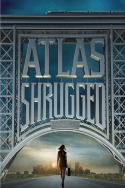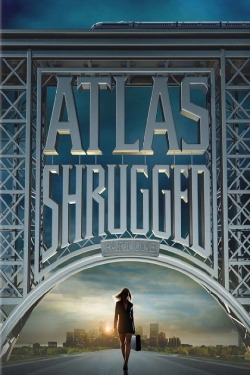
Review of Atlas Shrugged: Part I (2011) by Byron G — 24 Apr 2011
There is an ongoing argument about the praise the Atlas Shrugged movie is getting from the novelâ(TM)s followers versus what liberal film reviewers are calling it. This film is atrocious from a mere aesthetics perspective: from the directing choices, the actorsâ(TM) performances, the scene selections, the dialog, the âspecial effects,â? the choice of plot, the sound of the audio, the musical choice, etc. All are wrong. The script, period, is trash because it simply doesnâ(TM)t miss but outright ignores the soul of the novel. Atlas Shrugged is not just a novel explaining the political philosophy of objectivism, but showing how the political philosophy of objectivism is fundamentally justified by its epistemology.
The argument made is: how does one show such a concept in a film? Instead of answering this question, the filmmakers avoided it and instead decided to tie in the political story of the novel into what currently is going on in America. This was a smart choice in gaining viewers from the Tea Party and the Republican Party but as a great insult to objectivism. A simple argument can be made: if something is worth doing, then itâ(TM)s worth doing right. Rand wrote a novel that has inspired minds for five decades now. The novel is about men going on strike not because the politics of the world are wrong, but the philosophies of the world are wrong. Its politics are carved by its philosophies. Instead of showing this, the filmmakers rushed out a short film about the errors of the current government that plays out like a ninety minute trailer for a film I kept waiting to start (much like watching an Uwe Boll film).
Every scene kept skipping the most important parts of that scene in the novel. When Dagny confronts Lillian on the bracelet of Rearden metal, she says to Lillian âIf you are not the coward that I think you are, you will exchange it.â? Dagny is addressing Lillianâ(TM)s philosophy that she feels she is owned by Rearden, and in her own way, Dagny is admitting to her own view of Rearden at that moment. Of course, Rearden wants to slap her, but in the movie, he smiles. A plain, horrible choice for the character by the director and actor: to play him as a coward. This is seen again in the love scene between Rearden and Dagny, in which Rearden admits to feeling guilty beforehand and the proper assertions of philosophy the novels shows are ignored in the movie. (âIt was like an act of hatred, like the cutting blow of a lash encircling her body: she felt his arms around her, she felt her legs pulled forward against him and her chest bent back under the pressure of his, his mouth on hers.â?).
Or the choice of the filmmakers to change the location and the mood of the scene in which Dagny begs Francisco for money, and leave out his warning that Galt will come to claim his line. Here, Francisco is also played as a coward. The entire San Sabastian event is left vague in the movie and its importance is undercut. No mention as to the depths that Francisco went to in order to shock his moochers and why. Itâ(TM)s left as if everyone watching would simply understand. A huge decision of the filmmakers was to skip the entire back story behind Dagny and Francisco, mainly, their love story. This is a pretty acceptable choice but leaves the viewer to piecing together Dagnyâ(TM)s hatred of Francisco. Take Franciscoâ(TM)s speech with Rearden, dimmed and dumbed down. The words were spoken as if without meaning to the actors.
Or Dagnyâ(TM)s scene with Dr. Stadler, which is vague, short and makes very little sense. It ignores the lines in which Stadler reveals his view of science and truth: âIt is only in the realm of pure science that truth is an absolute criterion. When we deal with applied science, with technology â" we deal with people. And when we deal with people, considerations other than truth enter the question.â? (which very much relates to politicized science like global warming) He continues âQuestions of truth do no enter into social issues. No principles have ever had any effect on society.â? Menâ(TM)s actions are directed by ââ¦the expediency of the moment.â? The movie skips Stadlerâ(TM)s gripe about the science institutesâ(TM) failure of a metallurgy department which gives Stadler a sense of envy toward Rearden. The film also skips Stadlerâ(TM)s intro to the story of his three greatest students, his line âAt your age, I had the same faith in the unlimited power of reason. The same brilliant vision of man as a rational beingâ¦.â? Faith in reason is a contradiction; reason deals with facts and truths, while faith deals with what one wishes to be true in spite of reality.
Of course they included a version of the scene between Dagny and the Union Rep, but not the scene that follows, where every engineer of the Taggart Transcontinental wanted to run the Galt line. Where is Halleyâ(TM)s fifth concerto? Or his fourth for that issue? The music shouldâ(TM)ve played an important part, but sadly, did not. The movie goes half-ass into the story of the motor and the dollar-sign cigarette but rather hasty and without essence (which is really the feel of the entire movie).
The first scenes of the movie show the filmmakers felt they could take a lot of liberties with the story, and so they reveal Galt without his face, saying emotionless lines cut up from the novel as if he doesnâ(TM)t understand what he is saying. Why does Galt believe in individual achievement and rational selfishness? The filmmakers blank out. Why does Galt believe men should be free: free from government, free from other men? The filmmakers blank out. Why would Galt go on strike against enforced collectivism? The filmmakers blank out. Why does Galt take it upon himself to become what Dagny refers to as âthe destroyerâ?? The filmmakers begin to refer to the motor factory, but skip the philosophies that led to its destruction. The entire film is a series of choices showing their fear to indulge in comparing objectivist philosophy with the leading philosophies of the world. What, then, was the point of making this movie?
This review of Atlas Shrugged: Part I (2011) was written by Byron G on 24 Apr 2011.
Atlas Shrugged: Part I has generally received mixed reviews.
Was this review helpful?