Review of Annihilation (2018) by Joylit — 23 Feb 2018
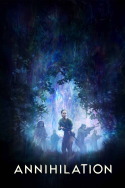
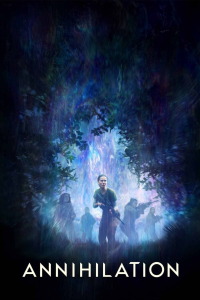
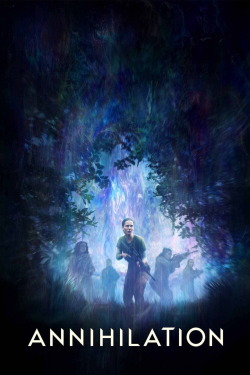
"Annihilation" is based on a novel of the same name by Jeff Vandermeer, a writer specialized in a sci-fi/fantasy sub-genre known as "Weird Fiction". This book is the first from a trilogy: the "Southern Reach Trilogy"; however, director/screenwriter Alex Garland ("Ex Machina") wrote this adaptation before the next two books were even published. "Annihilation" follows the story of a Lena, a biologist with military background, whose life has been shattered by the disappearance of her soldier husband who had gone on a secret mission into an ecological disaster area presumably harboring by an alien presence. At the beginning of the movie, we witness the return of the hubby, who unexpectedly comes back home in a confused mental state, soon becomes ill and is taken to a secret facility together with his wife. The place is a scientific research installation, built on the vecinity of an ever growing quarentined site known as "Area X", which comprises a coastal area and its adjacent forest, permanently enveloped in a phenomenon called "the shimmer"; this is an iridiscent wall of light that enshrouds the entire area, disconnecting it from the external world, which originated years prior when a meteorite hit a nearby lighthouse. Little is known about what is going on on the other side of "the shimmer", since several expeditions have gone missing and its members are presumably dead. Lena will meet doctor Vendress, a psychologist and authority figure, who explains to her that her husband is in the facility, suffering from multiple organ failure and massive bleeding. Both women agree that Lena should be part of the next expedition to Area X (it is argued she might be able to find a cure for her ailing husband), an all-female team that includes the rather obscurely motivated psychologist, all of whom seem to have very little to lose appart from their own lives. The movie weaves different timelines in a very seamless way: the very beginning is an interrogation scene where Lena is being inquired by a scientist about her experience in the Area X and the fate of her party; the second timeline kicks off with the husband's reappearance and continues with Lena meeting the members of the expedition and departing into the unknown. There are also flashbacks of Lena's immediate past with her husband, which provides information about their relationship that is crucial for establishing the dramatic core of the story. Alex Garland shows an assured hand with the complex narative, a combination of economy and elegance that that is both elocuent and easy to follow; this allows him to introduce different layers of meaning within the narrative (psychological, scientific, philosophical), and to tackle big themes without becoming pretentious or obtuse. The movie has memorable dialogue not included in the original novel and the characters are much more fleshed out (the conversation between the biologist and the psychologist about the nature of self destruction is a highlight, and a pivotal moment in the film).
As someone who have read the books, I have taken notice of the multiple changes that have been introduced by Garland, and even though a favorite character and storyline from the novel have been eliminated, and some elements have traded background/foreground places, I appreciate the way the director has made this story his own, taking enough from the book to make the story recognizable, but at the same time making his own interpretations and connections, expanding on its themes and characters. There is much wonder, weirdness and visual poetry to be found in the beautiful and exceptionally well crafted film, and to my surprise there is also plenty body horror and sudden outbursts of gnaly monster action, with one scene being particularly brutal and effective. This is a film where you can clearly appreciate the simbiotic relationship between these two highly imaginative thinkers, maybe the best collaboration since Kubrick and Arthrur C. Clarke in "2001: An Space Odyssey"). "Annihilation" represents the type of reflexive science fiction that ponders about our place in the cosmos, our intrinsic mutability, and the horrors this conjures; it amounts to a surreal, sciency phantasmagoria about desintegrating identity, deeply rooted in cosmic horror. It is the rare high concept movie that is both extremely entertaining and dazzingly thought provoking. And I have no words to describe that climax apart from saying it left me in complete awe. This is for sure a new sci-fi classic that consolidates Garland as one of the major sci-fi visionaries of our time.
This review of Annihilation (2018) was written by Joylit on 23 Feb 2018.
Annihilation has generally received positive reviews.
Was this review helpful?