Review of Annie (1982) by Gareth R — 07 May 2009
I know a lot of people like Annie, but to be honest, having just watched it, my head is in my hands. It's awful. Horrible. Spectacularly, nightmarishly bad. It's easily the worst musical movie I've ever seen, but the horrific direction, mystifying casting and convoluted script must surely rank it among the most excrutiating film experiences I've ever endured. Where. To. Start?
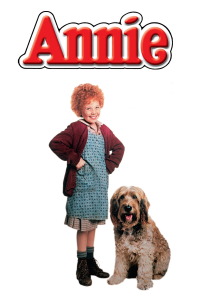
The movie opens with the same problem as the stageshow: the story just doesn't start with a bang. Stuck in a dismal orphanage run by an abusive drunk, Annie (Aileen Quinn) is a mother-figure of sorts to the other kids. Her hobbies include escaping - and not, bizarrely enough, running to fetch help - and one morning she gets out in a laundry basket, meets a dog she calls Sandy and gets promptly recaptured. (This escapade is as pointless as it is on stage: the plot, such as it is, starts afresh right afterwards.) Grace (Ann Reinking), PA for billionaire Oliver Warbucks, wants to pick up an orphan for a week. The reasons for this are too sketchy - again, they're also sketchy on stage - but off goes Annie to the Warbucks mansion.
So far, so flawed. The film completely fails to establish The Great Depression as its backdrop: it could be set any time. The orphans are supposedly abused by the drunk Miss Hannigan (Carol Burnett, the shining and delightful best thing in this), but they antagonise her so much that they're strangely unsympathetic. Annie, for some reason, never makes any attempt to rescue them. It's not clear why she's even staying with Warbucks, and two crucial plot elements - the broken silver locket and the letter she kept from her parents - are not set up at all. It's not a confident start, marred by the hopelessly incompetent direction of John Huston. The man behind The Maltese Falcon somehow displays an almost Ed Wood inability to frame shots, and consistently makes all the wrong decisions with the flat musical numbers.
Things judder even further downhill with the arrival of Warbucks. Albert Finney is, suffice it to say, miscast. Playing the billionaire like an alien robot impersonating Frankenstein's monster, he's a completely baffling creation and is strangely awkward to watch. For some reason he never gets any quality time with Annie - lest we forget, the whole point of the story is that Annie melts his heart - rendering his ultimate decision to adopt her meaningless. (The reasoning is even muddier when it seems he's doing it just to make Grace happy - but again, there's scarcely any evidence he likes her, either.) Finney's performance is one big What Were They Thinking?. Edward Herrmann, here cameoing as a mindlessly optimistic Franklin Roosevelt, would have been a far more suitable choice. Anything, however, is preferable to Finney's gurning disaster-zone of a performance.
Annie herself isn't bad at all - although Quinn's unspectacular singing voice suggests she was hired for her hair-do - and it's a fatal shame that she fades in and out of the story with shrugging irrelevance. Annie is too passive a heroine in the version I saw on stage, and she's a shade more interesting here, but her various relationships are all so badly botched that the whole thing could easily be about Sandy, her otherwise pointless canine companion, and it wouldn't make a huge amount of difference.
Tim Curry is the so-called villain of the piece, but (in his all-too-few scenes) he never gets any kind of handle on the role of Rooster. Shooting for devious and instead just looking bored, he's given more to do in a finale that goes wildly off the stageshow's rather modest rails: Miss Hannigan, her brother (Curry) and his girlfriend (Bernadette Peters, pointless) kidnap Annie and make a break for it, eventually scaling a raised bridge. Annie is rescued by Punjab, Warbucks' magical-powered Indian butler, via an autocopter. And if any of that seems remotely in keeping with the story, or with the supposed time period, then congratulations: you're almost as mad as this movie. After two hours of poorly-explained and appallingly shot misery, this ending seals the film's fate.
If you're wondering why I haven't mentioned the actual music, there's a good reason for it: it's forgettable. Hard Knock Life is okay simply because it's got a memorable tune, but the music behind it is drab and simplistic. Many of the other songs disappear from memory while they're still on, and the film's one bona fide classic - Tomorrow, of course - is delivered a paltry once, flatly, almost without music, in a scene that highlights Huston's dismal determination to get the least out of his camera. What a waste! Apart from that, the choreography is generally short-changed by the close-up-obsessed filming style, and the songs add very little to the story.
Apart from Aileen Quinn, who is likeable enough as Annie, the highlight is Carol Burnett. Mean but sympathetic, she rescues her scenes and outshines Tim Curry with enough wattage to give him a crippling sunburn. It's a pity her character doesn't make much sense - for God's sake, why is she doing this job? - but then, what does? She's ultimately a lot more likeable than the mean brats she's looking after, who - in Annie's absence - develop an almost Lord Of The Flies heirachy that finally pushes them from Naughty to Despicable. It's one of many spectacular missteps in a film that veers all over the place like a human pyramid on a rollercoaster.
Nauseating and mystifying, Annie has a lot in common with Huston's Casino Royale, also a heinously botched production that aimed for madcap and succeeded only in irritating its bored audience. At least it had a sublimely appropriate David Niven in it, though, and at least some of the disparate scraps had potential: it was their inclusion in the same film that killed it. Annie is a doomed enterprise right from its flat start all the way to the startlingly misjudged finale, and I spent much of the film hoping to wake up screaming from what - please, I'm begging you - really just a nightmare. No such luck.
This review of Annie (1982) was written by Gareth R on 07 May 2009.
Annie has generally received mixed reviews.
Was this review helpful?