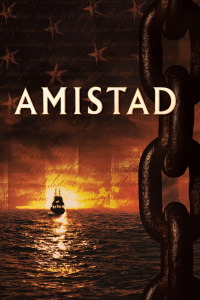
Review of Amistad (1997) by Paul Z — 08 Jun 2010
Slavery in and of itself could, I imagine, be viewed essentially as an issue of legalese and territorial ownership, at least to those taking advantage of it. One of the confounding truths offered in Steven Spielberg's Amistad is that seven of the nine U.S. Supreme Court justices in 1839 were slave-owning Southerners. His skillfully made Dreamworks opener zeroes in on the statutory condition of Africans who rebel against their abductors on the high seas and are brought to trial in a New England court. Slavery itself is not the core of contention. Rather, the court must choose whether the defendants were born of slaves, in which case they are guilty of murder, or were illegally brought from Africa and therefore had a right to rise up against kidnapping. But the law's clarification is not distinguished as much as it could have been for a movie with that as its core issue. The international slave trade had been abolished by treaties by this time, although those who were already slaves continued to be owned by their masters, as did their children. The ethical cutting of corners of that clarification is extremely cold-blooded, but on it relies the defense of Cinque, the leader of the Africans, and his comrades defiant.
Amistad, like Spielberg's Schindler's List, is not just indignant opposition to moral deprivation. We do not need movies to persuade us of the evil of slavery and the Holocaust. Both films are about the ways good men attempt to collaborate pragmatically within a morally deprived government to clear merely some of its prey. Schindler's techniques are brilliant, create tension, and result in a more arresting and impactful film than the bureaucratic stratagems in Amistad, where lawyers in powdered wigs attempt to decide the homeland of men whose language they do not speak. Having nothing to do with the ethical quandaries concerned, Schindler's List works better as a story as it is about a tightrope con game, while Amistad is about the hunt for a determination that, if found, will be of minor importance to the millions of other slaves. On the whole, the movie doesn't have the sensory explosiveness of Spielberg's seminal historical films, Schindler, Saving Private Ryan, The Color Purple and Empire of the Sun, which all moved me to tears.
The instances of the most feeling in Amistad transcend the central story. I speak of a mortifying scene where, with food running low on the ship, the less durable slaves are chained together and thrown over the side to drown so that more food will be left for the rest. And another sequence in which the bilious innards of the slave trade are gazed upon, as Africans kidnap people of rival groups and sell them to slave traders. A scene where Cinque sees African violets in John Quincy Adams' greenhouse and is crippled by nostalgia. And Cinque's recollection of his wife left in Africa.
What is most vital about Amistad is how it gives faces and names to its African characters. The slave named Cinque emboldens as a memorable human being, a once-free farmer who has lost his wife and family. We see his wife, and his village, and something of his life; we grasp how heartlessly he was torn from his life and dreams. He speaks no English, though takes in a little while in prison, and a translator is found who helps him communicate his human disgust at a legal system that may free him but will not acknowledge the all-too-obvious essence of the crime against him. He learns enough of Western civilization to discern its dissonances, as in a scene where another slave expresses with an illustrated Bible how he can relate to Jesus. And there is that inevitable moment between lawyer and client in which McConaughey's character finally talks to Cinque as a man and not as a rook on a chessboard. "Give us free!" Cinque cries in an immense scene in the courtroom, causing all to confront how little a "not guilty" verdict would matter to the absolute reality of his case.
Djimon Hounsou's performance relies considerably on his screen presence, which is a powerhouse. Some of the other performances are somewhat let-downs. I was taken aback by how little substance or screen time was given to the Morgan Freeman character, a former slave turned abolitionist who in his few scenes tells of the mines of humanity that stay buried. Maybe that's the point: It's not about being black at the time; it's about the laws of the time. Matthew McConaughey is obligated by the film to have his head in the clouds as the defense attorney; he plods along from cold-hearted legal objectivity to a touching realization of sympathy that we were all expecting, and while we are satisfied for him we are not by any means much moved. Nigel Hawthrone plays Martin Van Buren, who is portrayed as a waffling case of backbone deficiency who just wants to keep the South off his back. Another fun highlight is how he is accosted with demands by the Queen of Spain, played by a pubescent Anna Paquin, who is upset that she can't have the new toys she was excited to get.
The axis of this film, basically, is in Anthony Hopkins' haunting performance as old John Quincy Adams, who speaks for 11 minutes in defense of the defendants, and holds the courtroom, and us, movingly absorbed. It is one of the great movie courtroom speeches. However in applauding it, I broach the film's main concern: It is too much about the law and not enough about the victims. That John Quincy Adams triumphs in his noble cause is a wonderful accomplishment for him and a huge weight off Cinque's shoulders and his follower slaves, yet in the tragic entrails of American slavery, it is a somewhat superficial victory.
This review of Amistad (1997) was written by Paul Z on 08 Jun 2010.
Amistad has generally received positive reviews.
Was this review helpful?