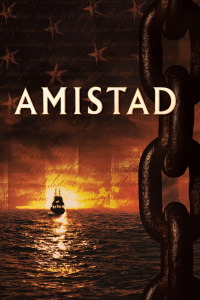
Review of Amistad (1997) by Moviemastereddy — 02 Apr 2016
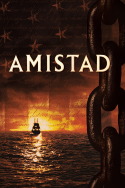
The forces of power, racism and justice momentously clash in Steven Spielberg's epic drama "Amistad," an artistically solid, if not always dramatically exciting, chronicle of the 1839 rebellion on board the Spanish slave ship of the title. True story is presented as an international intrigue of a high order.
Boasting a high-voltage cast, led by Brits Anthony Hopkins and Nigel Hawthorne, Americans Morgan Freeman and Matthew McConaughey, and, most impressively, West African Djimon Hounsou as the rebels’ leader, this second release from DreamWorks should sail safely as a message film that touches on the very fabric of the American social system.
Spielberg’s second foray into African-American history is far more effective and moving than “The Color Purple,” his compromised, sanitized rendition of Alice Walker’s novel. Thematically, the new film is a logical endeavor following “Schindler’s List,” though stylistically the two films are very different. Aiming to instruct as well as entertain — and often struggling to reconcile these two divergent goals — “Amistad” lacks the subtlety of tone and the simplicity of form that made the 1993 Oscar-winning film so special in Spielberg’s oeuvre.
The director strives a tad too hard to emphasize the universal elements of the 19th-century case of injustice, using a deliberate visual style that accentuates (and often inflates) every single idea and image. Spielberg skeptics will find ammunition to criticize “Amistad” as too solemnly earnest and too bombastic in its visual strategy.
In a powerful pre-credits sequence that evidences a conspicuously bold touch, Spielberg shows how Sengbe Pieh (called Cinque by the Spaniards) begins the rebellion when he breaks free of his shackles. This violent scene (partly responsible for pic’s R rating) depicts graphically with mega-closeups and rapid montage the impalement of an officer on a sword.
From this point on, David Franzoni’s multifaceted script relates the saga from the perspective of its central victim, a once free rice farmer who suddenly found himself a chained slave. With Cinque (Hounsou), the filmmakers provide the audience a most sympathetic figure — and an emotional hook — to absorb the sprawling drama as it hops from one continent to another.
After the rebels are caught and thrown into a New England prison, story switches to Theodore Joadson (Freeman), a former slave who has joined forces with a businessman called Tappan (Stellan Skarsgard) in the Abolitionist cause. When the Amistad incident breaks, the American press labels it “a massacre at sea,” but Joadson perceives the Africans as freedom fighters. Attempting to enlist a decent attorney, he ends up with Baldwin (McConaughey), a shady property lawyer nicknamed “Dung Scrapper.”.
For Baldwin, the case represents a property, not a human rights, issue. Indeed, in the trial, positioned against Holabird (Pete Postlethwaite), the nasty government prosecutor, Baldwin tries desperately to prove that the Africans were not legally slaves, that they were “stolen goods” because they were born in Africa and illegally kidnapped from their homes.
The case goes to the Supreme Court, where the Africans are defended by none other than John Quincy Adams (Hopkins), the former president and son of founding father John Adams.
Though there are a number of trials, Spielberg shrewdly avoids the routine format of courtroom drama, instead seamlessly integrating the numerous characters and their particular stands on the case. Yet every once in a while one senses an inner tension between Spielberg the mass entertainer, with his assured command of facile camera and trademark pyrotechnics, and the genuine artist, pressing for the simple core of the drama.
Occasionally, the film succumbs to the level of an anthropological survey, viewing the Africans and their rituals as exotic curiosity, though Hounsou’s dignified portrayal of Cinque as a man of outer strength and inner peace successfully counters this weakness. Regrettably, the always brilliant Freeman is totally wasted as Joadson, functioning as no more than a link among the various episodes, a possible result of the fact that his fictional character is a composite of several historical figures.
Cast against type, with shabby beard and big glasses to deglamorize his natural handsomeness, McConaughey renders a passable performance, failing to grab the opportunities of his substantial role. Playing a man older than his age, Hopkins shines throughout, and once he takes center stage he ignites the screen with a bravura 11-minute argument that results in the freeing of the slaves and crushing the notorious Lomboka Slave Fortress.
“Amistad” is an aural and visual pleasure, due to John Williams’ emotional score, Janusz Kaminski’s vibrant lensing, Rick Carter’s accurate production design and Ruth Carter’s verified costumes, all contributing to an authentic experience.
This review of Amistad (1997) was written by Moviemastereddy on 02 Apr 2016.
Amistad has generally received positive reviews.
Was this review helpful?