Review of American Madness (1932) by R.c. K — 07 Dec 2007
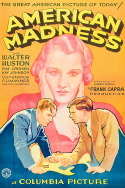
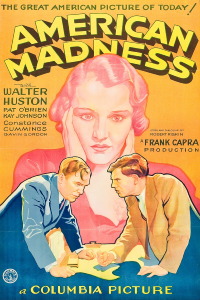
I last saw Walter Huston (father of John Huston, who directed The Maltese Falcon--the version that matters--and had his father in an uncredited cameo in it) as Jerry Cohan, father of George M. Cohan in Yankee Doodle Dandy. As with most films from those few decades, I feel there was definitely a sense that even the actors around the stars had honed their craft on the stage for a long time, even if they were making their film debuts. Here he is the clear star as Thomas Dickson, who runs the Union National Bank, under pressure from his Board of Directors to merge with the New York Trust and resign, saving them his heart-stopping loans made on faith.
Under him are people like Matt Brown (Pat O'Brien, Jerry Connolly to me, priestly friend of Rocky Sullivan in Angels with Dirty Faces), who Dickson hired after Brown robbed him and appointed Chief Teller, and Cyril Cluett (what a name had Gavin Gordon's character), a man who has a large gambling debt to gangster Dude Finlay. Matt is in love with Helen (Constance Cummings), secretary to Dickson, and the two witness Cluett's attempts to woo Dickson's wife Phyllis (Kay Johnson). Now a convergence of events--Dude Finaly calling in Cluett's debt, Cluett's attempts to start an affair, Matt's criminal history, a robbery, a rumour, the Board, headed by Clark (Edwin Maxwell) trying to pull Dickson out of the bank--leads to a pretty tense, constantly engaging battle against the odds.
Is this a Capra movie? Well, it's my first, so I couldn't say with any sense of expertise, but based on what I've always understood of Capra's work, my tentative response is actually a pretty firm "yes." Dickson is a man who has faith in other men--he says he makes his loans based on hunches and impressions of the character of people. He refuses to hold onto massive cash amounts and refuse loans to people who don't currently have anything to show for their ideas or needs, he is in some ways naïve when it comes to this, and certainly focused. Phyllis is only tempted away from him because she feels ignored, passed over for Dickson's work at the bank. He would never suspect this, though, because of the faith he has in people. However, in what I understand to be Capra style, we can see from the beginning that Matt is a trustworthy character, through and through, taking Dickson's appreciation of him to heart and feeling like he is a surrogate father.
The title certainly refers to the sort of madness that seems almost uniquely American. Dickson feels that money should be cycled out in loans and the like because keeping it in circulation promotes the national economy by keeping things moving and not allowing the stagnation of keeping it all held in bank vaults. This is certainly relevant to the time period--the Great Depression--and is, while perhaps idealistic, is at least portrayed as the right idea to have. Yet, all the same, the telephone operator for the bank who we open on tells others, through gossip on one of her lines, about the robbery, leading to a fantastically filmed run on the bank for everyone to withdraw the funds they feel are now unsafe, a masterful scene following of jump cutting between phone calls of everyone passing and exaggerating the rumour until a massive tide of people swarms over the bank, the throngs yelling at each other and the bank itself as they all rush to guarantee their financial safety--or so they think--all because of a rumour, instead making their own problems worse.
This is a short movie (around 76 minutes) but is absolutely filled, feels no excess and no loss. As is typical of earlier talking films, lines are crammed into short spaces, actors prattling on rapidly but with great emotion, speaking at speeds that are real but not overly natural, the entire experience sort of like a hyper-speed stage production While I've mentioned many a time that I prefer a natural approach and tend to be most impressed by it, the interesting thing about films from the 1930s and 1940s is that they have this lightning patter, yet the skill and experience of all the actors somehow brings a natural element to it all the same--emotion is clear and true, and manages to mask the unrealistic speed of everyone's speech, managing then to keep the pace rapid and suspenseful with these speeds without violating our suspension of disbelief. An extra note beyond the main cast I've already mentioned belongs to Robert Emmett O'Connor as the Police Inspector who comes to investigate the robbery, a smart man, a quick man, a perceptive man, alternately pleading and demanding where appropriate.
I am fantastically happy with this first Capra experience. It brought a smile to my face and made my eyes tear up a little--admittedly I sometimes seem to be more vulnerable to this than other times, but this time it was a sort of happy appreciation of human decency. And that's actually the point, I guess. I don't think movies have to be happy, or have to be dark, or hate one or the other, I just think they should live up to what they set out as. They may set out as one and build themselves into the other, but it should be natural, whichever--or whatever--it is, and so I think the people who hate Capra's appreciation of the little guy winning out and people proving that maybe, just maybe they're decent can go to hell. Sometimes I want to have a little faith in humanity. I don't think it's anymore realistic to say we're all bad than it is to pretend we're all good--and I didn't get the feeling Capra was implying we were all good, even if good has some chance at winning out. Cluett was no great shakes as a person (though he had a little decency every now and then), and the maddened, ignorant mob was portrayed as selfish, egocentric, callous, negligent and eventually even hypocritical.
Fantastic stuff. I can't wait to see more.
This review of American Madness (1932) was written by R.c. K on 07 Dec 2007.
American Madness has generally received very positive reviews.
Was this review helpful?