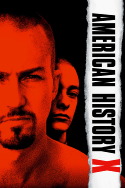
Review of American History X (1998) by Cameron J — 05 Apr 2014
"Mel Gibson 101"! Seriously though, if they wanted Ed Furlong's character to cut down on the neo-Nazism, then they shouldn't have put him in a program called American History X, because that sounds so radicalist that I can see the promotional posters with the "X" bent into a swastika. ...Man, having just said that, I'm feeling guilty about how I can't help but think about how that sounds like a cool name for a social studies class, which isn't to say that I'm recommending that youths take it, because you might end up actually walking into a class promoting youth Nazism. You know what, if there is a class promoting neo-Nazism, while I don't condone it, the people from this film and "Romper Stomper" might want to consider entertaining it and getting an education on their subculture, because looking at how they are in anti-Vietnamese in "Romper Stomper" and anti-black and Mexican in this film, it seems as though they're attacking everyone except Jews. I'm sure Tony Kaye is glad of that, because he's so Jewish that he actually looks like a rabbi, and if that confuses my fellow prog rockers out there, no, I'm not talking about the Tony Kaye who originally played keyboards for Yes. Well, it might be, because it doesn't seem like there would be enough Jews in England for two of them to be named Tony Kaye, although it should be noted that this Kaye's artistic endeavors are hardly as upbeat as music by Yes. Man, this film is so blasted brutal, and so blasted good, and yet, not unlike its leads, it's got its share of problems.
Both steadily thoughtful and lightly intense, this film is surprisingly pretty tight on the whole, and when it isn't, it's not completely all over the place, but it's still sloppy enough to throw you off with its breaking of moments of momentum, if not intensity, with limp spells that retard a sense of progression, yet is still not as disconcerting as uneven areas in focus. It's pretty impressive how this film is able to stretch a somewhat small-scale basic story concept to a two-hour runtime pretty organically, but there are times in which the film gets just carried enough with its plotting expansions to lose consistency, at least when it incorporates flashback segments, the most jarring of which being the unbroken "prison-time" one that claims the primary focus of the narrative a little too much for comfort as a particularly prominent reflection of an overambition to milk this subject matter for all its worth. Of course, no matter how hard the film tries to or how successful the film is at fleshing out a narrative whose core story spans only about a day, and branches off into storylines that are of only so much dynamicity, there's still a certain minimalism to this narrative that would limit dramatic potential in a less-inspired drama, but still establishes a certain dramatic sensitivity that cannot afford to be handled rather heavy-handedly. Alas, there are times in which the film gets carried away with its dramatics, even within a script by David McKenna that, despite its thematic intelligence and dramatic sharpness, has disingenuous attributes to unsubtle dialogue and happenings, or at least has questionable dramatic attributes that come off as disingenuous when carried away by Tony Kaye. Kaye's debut directorial performance is truly triumphant on the whole in its tight, realized handling of worthy themes and layered dramatics in a refreshing, entertaining and powerful fashion, but there's still something kind of, maybe even extremely rusty about his dramatic storytelling, whose heavy-handed thematic visuals and overplaying on some overdramatic scoring taint this generally thoughtful film with near-cloying moments, many of which slip into, well, cheesiness, something that this film should be above, but devolves to a lot. It takes a long time to get used to this film's shaky dramatics, and once you do, it's hard to ignore more-or-less soaring inspiration that remarkably carries the final product through all of its unevenness and heavy-handedness and achieves bona fide excellence, but to tell you the truth, the inspiration in this film is so upstanding that it could have brought this drama of limited scope to the border of being masterpiece, something that it doesn't stand a chance of being with its being too ambitious for its own good. The film has many moments in which it's carried away, but it should go without saying that there are many more moments in which film stands out in its matching ambition with realization, in order to resonate and entertain, with a little help from colorful score work.
A little formulaic in her efforts, Anne Dudley turns in a very '90s score that, in all honesty, is sometimes overdramatically abused as rather cloying, but pretty powerful, at least by its own aesthetic right, which dynamically plays with sweep and soul in a fashion that is beautiful and, of course, complimentary to entertainment value, until actually well-utilized in a dramatic context that feeds on the musical soul which draws on resonance more than taints it. For this, you have to give some credit to the handling of the scoring by Tony Kaye, who, as I've said time and again, has some glaring subtlety issues, but turns in a generally outstanding debut directorial performance, which overwhelms heavy-handed visuals with an immersively well-staged visual style, particularly during the flashback segments whose black-and-white palette captures a sense of bleakness and progression towards the light of revelation, just as such memorable images that range from the market raid scene, curb stomp scene and prison rape scene, to a final act that is fully of hauntingly resolute symbolism join the aforementioned tasteful plays on musical soul to craft soaring, maybe even tear-jerking dramatic and thematic highlights that cut through all the potential dramatic limitations and pierce as a celebration of worthy subject matter, done additional justice by a worthy subject matter. David McKenna's script is thoroughly flawed, but through all of its missteps is genuine brilliance, at least in terms of sharp, often articulate, if a little theatrical dialogue and, of course, thematic value, for although McKenna's heavy-handedness superficializes certain dramatic elements, he is unflinching in his admittedly and terrifyingly accurate deconstruction of racial communities and relations, and modern social politics, balanced out by a deconstruction of extremist interpretations of very real social issues through an organic shift in focus to universal conflicts which plague people of all, if not particular ethnicities. Considering that this often dramatically heavy-handed script takes on gutsy themes criticizing liberalism and radicalism, it's easy for the thematic value of this film to make a seriously false move that either return the veil over the publics' eyes be denouncing worthy and sometimes overblown conservative messages as wholly radical and inaccurate, or even thin out the counter-messages enough to make the final product seem like some kind of radical propaganda, but in a feat of tight, intellectual scripting, the film tightly delivers intriguing themes, thus, if the final product is nothing else, it's a provocative vehicle for worthy messages, something that it is indeed more dramatically profound than, meeting heavy-handed moments with well-rounded areas in characterization and subtle intensity that capture a sense of resonant humanity as a portrait on family dysfunction, personal reformation and overcoming anger that is sold by Kaye's heartfelt direction, and anchored by heartfelt performances. Overblown directorial moments beget some underwhelming supporting performances, but when performances stand out, they shine, with Stacy Keach delivering the chilling charisma of a mastermind of organized supremacy, while Beverly D'Angelo and Jennifer Lien capture the emotional frustration of loved ones to questionably frustrated, and an almost secondary lead performance by Edward Furlong encompasses the disdain and personal confusion of a young man seeking his paths, both to anger and to human revelation, and both through a person he looks up to. These performances, in addition to those by, say, Ethan Supplee, or Fairuza Balk, or Guy Torry and others, don't simply outweigh the underwhelming performances, they soar, yet most everyone pales in comparison to the lead performance by Edward Norton, who makes this film with an almost career-defining performance, in which Norton nails the intense frustration and sense of pride in a neo-Nazi seeking justice for his own people in its most extreme form, before capturing a sense of evolution in Derek Vinyard that is nothing less than mesmerizing, due to Norton's effortless naturalist and nuanced presence which immerses the talent into his role and defines a man who undergoes a long, painful reformation that may very well have underwritten spots that are entirely obscured by Norton's unabating effectiveness. You have to see the film in order to see just how realized Norton is in a chilling, devastating and all around engrossing performance that reminds us the man's arguably ranking among the greatest actors alive, if not of all time, and that performance, alone, carries the film a long, long way, but not single-handedly, for although ambition slips into heavy-handedness much too often, what it does right it does so very well, thus making for a drama that is intriguing, moving and inspired enough to stand out through all of its misguided elements.
When it's all done and history, the uneven pacing and narrative structure, minimalist dramatic spots and often cheesy subtlety issues to writing and direction that has ruined other films of this type certainly threaten this effort, but on the wings of a sweeping score, thematically and dramatic genius script, powerful direction and visuals, and remarkable performances, - the most remarkable being that of the unbelievably sensational Edward Norton - "American History X" soars as an entertaining, deeply thought-provoking, devastatingly resonant and altogether triumphant drama.
3.5/5 - Excellent.
This review of American History X (1998) was written by Cameron J on 05 Apr 2014.
American History X has generally received very positive reviews.
Was this review helpful?