Review of Amarcord (1973) by Marco F — 13 Apr 2009
"Amarcord" ('I remember') is Federico Fellini's impression of a year in the 1930's: a surreal carnival of memories, it is a film with no plot, but with haunting images - caricatures of the petit bourgeoisie, satires of provincial institutions. Teachers are portrayed as inflexible, autocratic. The Church is obsessed with stamping out masturbation. Families are dysfunctional - a crazed uncle climbs a tree to shout that he needs a woman ... only to be coaxed down by a midget nun. The whole town takes to the sea to wait, late into the night, for a glimpse of a passing liner.
"Amarcord" is a series of loosely linked vignettes. A lawyer tries to act as ringmaster, giving us background information about the town of Rimini. It had been bombed flat in 1943-44. Fellini reconstructs fantastic memories of the place. Nostalgia, he implies, is fantasy - our reconstruction of memories as little dramas.
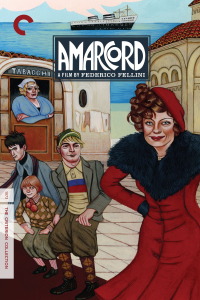
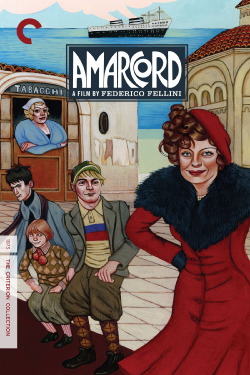
There is a monochrome quality to "Amarcord"; the actors wear dark clothing ... a few appear in red, such as the local hairdresser, Gradisca, focus of much teenage lust. The costumes evoke a sense of how and why that person is remembered.
If there is a central character, it is the town square, the focus of communal life. Here, the townsfolk come and go, participating in spectacles like burning an effigy of a witch or watching a Fascist politician deliver his speech.
The direction emphasises Fellini's affection for people. Fellini's politics is humanist rather than doctrinaire ... he invites an exploration of consciousness, famously asking his audience to see his films, not to try to understand them. Many of his films are autobiographical - you take to them and from them something of your own memories ... some shared feeling, some new insight.
Fellini turned his back on realism. He espoused the surreal. There is not necessarily any subject to the film. You, as viewer, are not there to be entertained, but to interpret, to deconstruct the work and evoke and reconstruct your own emotions.
Fellini plays with light and darkness; fog, smoke, snow, or a storm of seedlings caught on the wind obfuscate both the images and the memories. This is poetic film making. Fellini constructs his characters in two dimensions, then builds them into full-bodied people for whom you can feel affection and sympathy. It is the institutions - education, religion, family life, or Fascist organisations which are portrayed as farcical, grotesque and dysfunctional. People are merely fallible - the first narrator is an old down-and-out who appears to forget his lines and stumble over his words.
The actors look like real people - they are hardly glamorous. They are often grotesque, their physique, make-up, hair, and clothing taken to extremes ... the sort of extremes you find imprinted on your memory. Fellini dubbed the sound afterwards - often making the actors sound unreal.
If there are underlying themes to "Amarcord" it is Fellini's portrayal of the emptiness of Italian society, of a nation living on memories of the glories of Rome, so vacuous it failed to note the rise to power of morally and intellectually bankrupt Fascism. Fellini counterpoints this with an exploration of teenage sexuality. His teenagers are fascinated by bodily functions - gross, bawdy, inexperienced, and ultimately impotent.
Fascism is as impotent as teenage sexual fantasy ... and intellectually, it is every bit as insubstantial. When the townsfolk go out to watch the passing liner, a triumph of the Fascist state, they are eventually given the spectacle of a huge, two-dimensional image, lit up like a giant Christmas tree. It is obviously fake ... as illusory as the national identity created by the Fascists.
Not Fellini's finest work, but a fascinating series of images which will have a very individual impact. It is a film which benefits from being watched more than once. It may not get under your skin the first time ... but.
This review of Amarcord (1973) was written by Marco F on 13 Apr 2009.
Amarcord has generally received very positive reviews.
Was this review helpful?