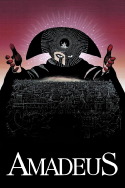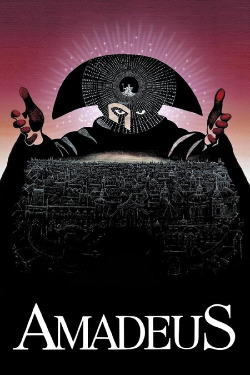
Review of Amadeus (1984) by Karl W — 07 Mar 2011
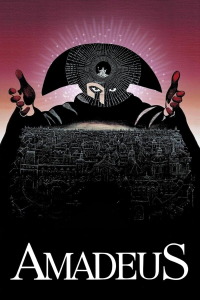
Introduction Amadeus (1984).
The film â~Amadeusâ(TM) is essentially a meditation on ideas about the superior and inferior in life despite the inherent contradictions in its presentation. The inherent contradictions stem from its presentation which centres on a mythical story about envy and so the film appears to have no foundations although it does have two foundations which are the envious Antonio Salieri (F. Murray Abrahams won the Oscar for best actor in a leading role for his portrayal of Salieri in this film) and the music of Mozart. This film seems completely implausible from a historical perspective but works because the portrayal of the conflict between Salieri and Mozart does the myth justice thereby making it a great film. Whether or not one accepts the concept of mythology you must always remember that myth has some grounding in reality. The reality I speak of is the mundane existence which we all endure day in day out. What myth does is to exalt the mundane in us and make it more palatable and this explains why we exalt our stars be it in music or film or sport. These stars are humans like us all but they seem to have qualities that do not reflect the mundane they have qualities that seem unearthly, almost godlike and this is where myth is born. Myth is an exaggeration of reality that is all. These individuals are not necessarily godlike they are merely perceptive or have a distinct advantage and we therefore claim that they are geniuses or godlike simply because the concept which they created was never developed prior to their arrival. The foundation of this film may be reality but the missing link here is speculation. When the startling effect does occur and shatters our mundane existence speculation becomes rife as to the causes or influences that influenced the direction of this particular moment. The myth is born out of this speculation but differs from it because myth normally constitutes a narrative or a logical sequence of events with speculation as its foundation however this speculation originates out of some startling real live experience. What the person who writes myth does is to dispense with those stories surrounding the event that seem implausible and then tie in those that add some gravitas to the story. Speculation is babbling whereas myth represents its logical opposite. With myth it would appear that the narrative has some grain of truth. This film is based not just off Peter Shaffers play but off the play â~Mozart and Salieriâ(TM) by Alexander Pushkin which influenced Shaffer. When the play â~Mozart and Salieriâ(TM) was written it reflected what was already reinforced in peopleâ(TM)s minds, that Salieri was jealous of Mozartâ(TM)s godlike musical talents and had him murdered. The events in this play were based off speculation or rumours however Shaffer expands on the reasons why salieri should be jealous: his vanity and the music of Mozart. Shaffers screenplay does not deviate much from the myth but simply expands it to the point where you have to see these two main characters as symbols of our humanity much like the Batman and the Joker. If there is one thing that myth is grounded in it has to be the reality that is human nature for this is the basis for the development of so called civilisation.
Whatâ(TM)s the film about?
Let me start by explaining what this film is basically about: Salieri the renowned composer of his day and loved by his contemporaries knows that he is inferior because of Mozart. He however resents the fact that god has chosen to bestow this superior musical talent on Mozart who he consider s creature or some wild man who employs scatological based humour in his escapades. Salieri cannot believe this because he thought that by giving his chastity to god he would be renowned and he would play music that would immortalize him. He, however, painfully finds this not to be so for as he tells the priest: â(TM)32 years (after Mozartâ(TM)s death), 32 years of watching myself become extinct. My music growing fainter and fainter till no one plays it at allâ(TM). This is no mere talk and the film balances this in one clever scene where Salieri, at first, plays for the priest (who comes to receive his confession after he screamed that he killed Mozart) some compositions of his that were popular when he was in his prime however the priest cannot recall these compositions and he might be forgiven because he is not so well trained in music. Salieri, however, knows that when something is immortalized even the most vulgar person must be aware and so he says, â~Aaah what about his one?â(TM) and so starts to play a tune of Mozart on his piano. Salieri is evidently not surprised that the priest knows the tune for he is able to belt out the notes. The priest, who is not gifted in music (a very clever device in the screenplay), says he was not aware that Salieri composed that tune; Salieri corrects him when he says â~that was not me that was Mozart...Wolfgang Amadeus Mozartâ(TM). It does not take long to establish that he is a vain man. He says to the priest: â~everybody liked me; I liked myselfâ(TM). This is the first element that demonstrates why he would be envious of Mozart for a vain man cannot see anything but himself and so when the spotlight shifts he is either humbled or becomes envious. It is human nature. While watching those apocryphal Jesus films (a mere retread of the gospels) while growing up I was struck by one statement made by John the Baptist and I am not sure if these lines are in the gospels themselves. While baptising and simultaneously telling the assembled congregation to repent John is asked if he is the messiah and John says, â~No I am not messiah; there is one who is coming that is greater than Iâ(TM). As he says this Jesus himself parts the crowd and is baptised by John and after his head emerges from the water a white dove perches on his shoulder. This is one case where a man is humbled however salieri refuses to be humbled and grows jealous. He will be eventually humbled because as mentioned before his music grows fainter day by day. It grows so faint that by the end he declares that he is the saint for mediocrities; he is their champion. A clever device is that when he says this, a resonant laugh from Mozart reinforces his ignominy. This reference to Jesus is crucial to this story for the religious based theme runs throughout the film. In the film the talents of Mozart are not attributed to a genius, although that is what we would call him nowadays, they are attributed to godlike attributes for as Salieri says â~God was speaking through this little manâ(TM). It is not Mozart but god himself that manifests himself as Mozart. This reinforces the religious theme associated with the story of Jesus. Everyone knows that Jesus was from a poor background and his main opponents would come from the members of the established church that had grown fat on success. The message that Jesus delivered has immortalized him whereas those members of the established church in Jesusâ(TM) day have been largely forgotten no matter how prominent they were in their own day. They will only be remembered as the ones that allowed Jesus to be crucified and this would therefore enhance the image of Jesus especially as he, despite being crucified, begged god to forgive them anyway (a completely startling event in its time). Jesus never enjoyed the fruits of his labour but his message was immortalized and so he was raised to the stature of being godlike. Likewise Mozart is said to be godlike because of his musical talents and he will be persecuted by Salieri on earth however his persecution or underhandedness will exalt Mozart for eternity. There is a significant scene that should not be missed and symbolizes Salieriâ(TM)s reputation as a devil. He realized that God would not grant him the gifts that he so desires so he breaks with god by throwing a crucifix into the flame. The main reason he gives for this is: â~why give me the desire? Like a lust in my body and then make me mute.â(TM) His desire was to be a great musician however he is mute but his desire to be great forces him to recognize greatness in another which is Mozart. This story is reflective of the apocryphal tale of the break between god and the devil when the world was just formed. It was because Luciphor was the right hand of god that he could acknowledge true power but he was limited because he was mute he simply had to follow but being the second in command, being so close, made him aspire. He was therefore humbled after the defeat by god and cast into shadow. The devil will always be remembered for the same reason that the captors of Jesus were remembered: as the one who always sought to undermine but in his effort to undermine exalts god even further. (I am sure some will believe that the devil has won some victories in the battle for the soul of man). This then is the role being played by Salieri. He wishes to undermine Mozart but fails miserably because it is Mozart whose music becomes immortalized whereas Salieri is only remembered as the underhanded achiever. There are many signs in the film that show that Salieri is renowned in his day and grows fat on success. Firstly, he loves sweet things and this motif establishes his penchant greed. Secondly, he is the court composer in Vienna and instructs Emperor Joseph and every tune that he plays is considered a masterpiece by his contemporaries even after Mozart just debuted with â~The Marriage of Figaroâ(TM) and â~Don Giovanniâ(TM). Salieri knows that these works are superior to any opera that he will ever compose but everyone else wonâ(TM)t know it for two reasons: Salieriâ(TM)s subterfuge and that the music is unfamiliar to his contemporaries. The emperor says after Mozart debuts with â~The Abduction from the Seraglioâ(TM) that, â~You (Mozart) have given us something quite new tonightâ(TM). He is not trained so well in music so he would not know why it is new. Salieri certainly knows why. Despite this the emperor decrees that one of Salieriâ(TM)s operas is the best opera ever performed up to that point (probably in Vienna the so called home of musicians in its day). If I was there I would have probably agreed because that is what the people are used to they are not accustomed to the strange music of Mozart and so they would rather stick with the mundane/familiar that is Salieriâ(TM)s music.
Mozartâ(TM)s Music in the Film.
Then how is the music of Mozart portrayed in this film. It is one thing to acknowledge that this music is greater than yours but how is that relayed to the average viewer. Salieri heard the stories of Mozart growing up during his youth: â~While I was playing childish games; he was playing for Kings and Emperors even the Popeâ(TM). He was prodigious certainly and this was why Salieri admired Mozartâ(TM)s father more than Mozart himself because as a child certainly Mozart would resort to childish behaviour as did salieri. Mozartâ(TM)s father having recognized his talent would have ordered Mozart to hone his musical talents and this would require some form of separation from his childhood (Have you seen my childhood? says Michael Jackson). Salieri meets Mozart for the first time in Vienna where Mozart has come to play â~at the Residence of his employer: the Archbishop of Salzburgâ(TM). I will not get into the politics here only to say that Mozart is considered a servant of the Archbishop in this film and this is something that Mozart resents. Salieri discovers Mozart in the room where the food is kept. Mozart and his wife to be Constanze are playing hide and seek. Salieri is revolted by the scatological (look it up) banter between the two but is astonished that when the music starts to play Mozart arises, assumes a studious air and says â~my music...theyâ(TM)ve started without meâ(TM). Salieri cannot believe this is Mozart, â~that dirty creature giggling on the floor; that was Mozart.â(TM) Mozart would seem dirty because his behaviour seems lowly and probably brings to mind the ideas of class. I say this for when Salieri speaks to Constanze(Mozartâ(TM)s wife) he says â~Dont call me sir. It puts me at such a distance. Iâ(TM)m from a small town just like your husband.â(TM) After the performance Salieri recounts to the priest the musical notes on the manuscript that was left on the podium while Mozart met with the Archbishop: â~the beginning was simple almost comic; bassoons, basset horns, like a rusty squeezebox but then an oboe hanging there unwavering before it was taken over by a clarinet. This was not the composition of a performing monkey (this reference to a performing monkey is a phrase from his father)â(TM). The film does not relay this message simply in dialogue for while Salieri speaks of Mozartâ(TM)s many compositions throughout the film the producers cleverly interspersed the actual recordings with his dialogue. One would then be able to understand definitively the greatness Salieri saw in the music of Mozart because you too are able to hear the music for yourself. This therefore makes the music a grounding element in the film. Salieri commenting on a series of compositions says, â~Music finished as no music has ever been finished before....displace one note and there would be diminishment.â(TM) His colleagues cannot understand the music of Mozart and their main complaint is â~too many notesâ(TM) or as Coutn Orsini Rosenberg (a composite fictional character based on an actual personage who did exist), a radical conservative, states â~A young man trying to impress beyond his abilities.â(TM) This may seem conservative but let us take a more theoretical approach to understanding the gravitas of this problem for it is a situation that is as old as time. What Orsini is hearing is the type of breakthrough that is bursting at the seams. When someone makes a breakthrough normally there is, or appears there is, no foundation for what he is doing. It appears as if it does not have structure; it appears as if it would collapse which is why salieri says â~displace one not and there would be diminishmentâ(TM). There are situations where people do not follow through with their breakthroughs; they see the opening but when they make the thrust they end up back where they started although the gap has been found. The real breakthrough occurs when you can push and push until you are literally soaring so that even if you fall people who were normally comforted by the existing knowledge will make the journey with you and so what was previously the accepted norm is replaced another. This is why you have the phrase â~up, up and awayâ(TM). The person making the breakthrough normally sees a vast range of possibilities. Moxart in his defense of writing an opera on the then banned play â~the Marriage of figaroâ(TM) says to the emperor â~the maid, is followed by the husband, then by the wife (all singing at the same time) septet, sextet, octet. How long do you think I can keep this (different harmonies) going your majesty? Just guessâ(TM) (The emperor guesses 8 minutesâ(TM)) â(TM)20 minutes sire and no recitatives (â~ a style of delivery (much used in operas, oratorios, and cantatas) in which a singer is allowed to adopt the rhythms of ordinary speechâ(TM). Wikipedia).â(TM) This would have been something amazing indeed but not all goes the way Mozart planned. The Emperor yawns once during this piece which is four hours in length. Mozart cannot understand why â~The Marriage of Figaroâ(TM) was not a success during its run at the National theatre and so Salieri has to explain to him( Mozart does not know that Salieri is trying to undermine him): â~The poor man (the emperor) can barely sit through an hour (of opera); you gave him four.â(TM) Mozart asks â~why did they (the Viennese public) not come?â(TM) Salieri answers, â~You underestimate our dear Viennese my friend. Did you know you did not even give them a good bang at the end of songs so that they would know when to clap?â(TM) Mozart replies â~I know, I know. Maybe you could give me some lessons in thatâ(TM). This obviously offends Salieri. This is therefore the struggle one encounters when he or she is trying to demonstrate a new product it must still have some.
This review of Amadeus (1984) was written by Karl W on 07 Mar 2011.
Amadeus has generally received very positive reviews.
Was this review helpful?