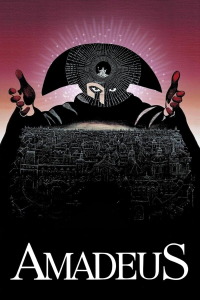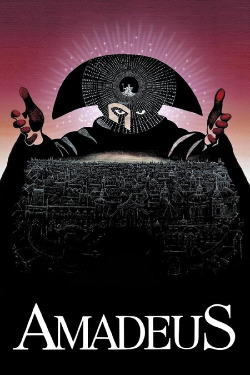
Review of Amadeus (1984) by Ross L — 10 Nov 2012
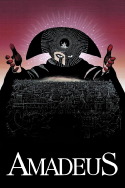
Milos Forman's Oscar-sweeping imagining of Wolfgang Amadeus Mozart's life, music, and death is a lush, energetic, witty, and historically dishonest movie. Based on a play by Peter Shaffer, the film has plenty to say about art, love, faith, and human nature, and says it flamboyantly, even if it couches those observations in a fundamental lie.
The fictionalized account of Mozart (played by an unforgettably joyous Tom Hulce) is framed through the hammy madhouse confession of his bitter, forgotten, and guilt-ridden putative rival in Vienna, the royal court composer Antonio Salieri (F. Murray Abraham, who won an Oscar for competently playing a role that is marvelously written). Recognizing and envying the implacable genius of Mozart's work but abhorring his proto-bohemian joie de vivre and blithe disregard for the protocol of proper Austrian society, Salieri hatches a hazy, quasi-metaphorical plot to bring about Mozart's untimely end through composition.
In Amadeus, art, which in Salieri's belief system flows from the divine through human vessels like the frivolous yet gifted Mozart but never through himself, not only imitates but overtakes and consumes life. Life is art and art is life, both inseparable in their very being. The free-spirited Mozart can summon art at will as an extension of his liberated worldview, but the prim, devout Salieri, with his black garb and his abstentions from vices and desires, has no access to it. This dichotomy extends beyond actions and attire (Mozart's ostentatious wigs and foppish clothing make him look like a glam rock star), but even regional accents: Abraham discourses in precise British English tones, where Hulce is pure American casual.
Applying the universal cultural assumption that true art belongs to the rebellious avant-garde and not to the well-heeled gatekeepers of bourgeois conventionality to the high-culture sphere of classical music is the masterstroke of Amadeus, even if it is a piece of unconsidered counter-cultural inherited wisdom. That this stroke is based on a distortion of Antonio Salieri's life, music, influence, and relationship to Mozart is perhaps not to the film's credit, mind you.
Although Mozart did resent the Italian domination of the Viennese musical environs (a presence which Salieri embodied) and the two men were rivals, they were friendly ones and mutual admirers. Additionally, far from being the "patron saint of mediocrity" (as the fictional Salieri dubs himself near the film's end), the composer vilified by Shaffer's adaptations was very prominent and influential in his own time, setting down many accepted standards of operatic composition in particular that subsequent (and more celebrated) composers followed and expanded upon and even teaching many of these future masters himself (including Schubert, Beethoven and Liszt). If his work is not as fondly-remembered as Mozart, well, whose is? Next to a Mozart, even accomplished composers seem like the measly incompetents.
As cinematically vibrant and thematically lucid (as well as just purely enjoyable) as Amadeus is, therefore, it is diminished, if only slightly, by this central figurative structuring around a historical mistruth. Its richness is diluted, its colours washed out. We can still be absorbed, but only if our disbelief is wholly suspended. A minor amount of extraneous research can threaten the entire conceit upon which the film is built, and that is a fragile frame indeed.
This review of Amadeus (1984) was written by Ross L on 10 Nov 2012.
Amadeus has generally received very positive reviews.
Was this review helpful?