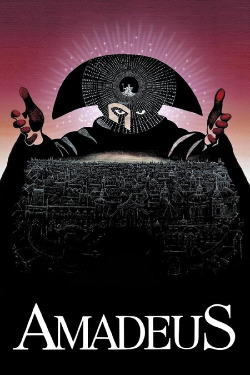
Review of Amadeus (1984) by Ashley H — 16 Nov 2016
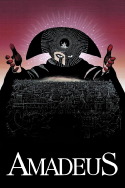
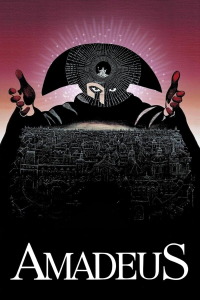
Milos Forman achieved directorial greatness with his 1984 classic Amadeus. The film starring F. Murray Abraham, and Tom Hulce tells the story of a jealous mediocre composer who believes he is responsible for the demise of perhaps the greatest composer to ever live. Amadeus is a film that will dazzle the entire way through, more than earning each of its honors from Oscar, including its top prize. Amadeus is a stark beauty, an instant classic, and one of the most visually stunning films of all time.
Amadeus opens with the suicide attempt of Antonio Salieri (F. Murray Abraham) leading to a confession that has been weighing on his heart for years. Salieri, a contemporary of Wolfgang Amadeus Mozart (Tom Hulce), lived his life insanely jealous of his exceptionally gifted counterpart. Salieri confesses to the Priest sent to converse with him after his suicide attempt, that he devised several plans in order to stunt Mozart's success. Salieri was fiercely jealous of Mozart's ability, and how seemingly natural that ability came to him, as Salieri devoted his life to composition mastery yet couldn't hold a candle to Mozart's compositions. Salieri promised his chastity to God in hopes of being imparted the gift of music by the hand of Christ. Salieri enjoys a comfortable living and career as court composer to Austrian Emperor Joseph II (Jeffrey Jones). The envy of Salieri eventually engulfs his entire being; he is dumbfounded as to why God could choose such an immature, petulant child to instill his most precious musical talents in. His envy has led Salieri to wage a war against the Christ he devoted his life to, and an urgency to bring about the downfall of Wolfgang Amadeus Mozart.
Amadeus is a beautifully striking film, thanks in no small part to its reliance on natural lighting. Amadeus was filmed solely using natural lighting and it benefits immensely from this choice. Amadeus taught me that lighting in a film can have the most dramatic impact, even acting as a character on its own. I am moved by the lighting every time I watch the film, and it is my favorite part of revisiting it. Amadeus achieves a curious feat, it is a biopic in which one cares little about biographic inaccuracies. There are no historical records to indicate that the relationship between Salieri and Mozart was contentious as it appears to be on screen, yet, the story is so engaging that the audience is not tallying the mistakes the film makes. It's more than an engaging story, however, that keeps the audience from becoming upset at the miscues the film fires; Amadeus strikes the delicate balance of giving each principle character their due in the film. Mozart and Salieri are deeply flawed, yet gifted individuals and Foreman brilliantly expresses both sides of each man.
The crux of the film has to do with Salieri's perception of God and the characters relation to God. Salieri makes a deal with God at a young age promising to devote his life fully to Christ in exchange for divine inspiration of his musical compositions. Salieri begins his devotion by solely studying music and vows to remain chaste, exercising extreme monastic-like discipline in his daily life. Salieri is pleased with the gifts he feels have been handed to him by Christ until he becomes aware of the superior expertise of Mozart. Salieri becomes obsessed with the idea of Mozart and anticipates the day in which he can meet the one God has given such musical talent to. When he finally meets Mozart, Salieri is shocked and disgusted by how juvenile the prodigy is. The interesting aspect of Salieri's repugnance is that he is so revolted by Mozart's childlike behavior, yet his fixation on the composer comes across like a son and outshone by his father's (God's) favorite child. Salieri knows he does not possess the talent Mozart does, yet believes himself to be more deserving of the superior talents. He begins to unwind right before the audience's eyes, decomposing from the realization that he has lived a life promised to another, yet, intensely unfulfilled. It is this great multi-layered portrayal of a jilted man that earned F. Murray Abraham an Academy Award for his role as Salieri; the role also won a Tony for Ian McKellen's brilliant portrayal of Salieri on Broadway. F. Murray Abraham played the part wonderfully and deserves each of the many accolades he received for his turn in the role. The standout for me, however, is the multi-faceted Tom Hulce. Hulce plays the childlike, workaholic, unsophisticated, professional composer. The rapid-fire shifts between facets of the boy genius are extremely well-acted by Hulce. A performance that necessitated so many opposite mindsets is no easy feat, yet one Hulce mastered with ease. As brilliant as Abraham and Hulce were in their roles, it would have been interesting to see Ian McKellen and Tim Curry reprising their stage roles in this film. (I wonder why neither were selected to star in the film having given acclaimed performances on Broadway).
The period costumes of the film were perfect, the elaborate set designs showcasing the time were brilliant, and it nearly goes without saying that a film about one of the greatest composers of all-time has a magnificent score. The makeup department had the dual challenge of creating an aged Salieri, and an ill Mozart, both feats perfectly achieved. Amadeus has a myriad of factors that could work against it. The film is three hours long, is narrated, involves heavily on flashbacks, and shows several compositions-operas mostly, of the featured composer's works. Yet, given the issues that may arise from these aspects of the film, Amadeus does not suffer for them. Amadeus is excellently paced, brilliantly illustrated through narrated flashbacks providing an in-depth look at the people involved in the story, and are wonderfully brought to life by seeing the pieces the composers worked so tirelessly on.
Biopics seem to rarely show the subject's death, but for Amadeus, it was almost a necessity to show the death of Mozart. It was through Mozart's decline towards death, in which we see Salieri attempting to aid in Mozart's composition of his final requiem, that we see just how superior Mozart was to Salieri, in Salieri's mind, anyway. Salieri referred to Mozart's natural music ability as if he had been picked to take musical dictation from God, this seemed to be supported when Salieri saw original copies of Mozart's work that showed no marks of corrections or signs of error. As Salieri is working with Mozart, he is taking dictation from the ailing Mozart, and having trouble keeping up with him or even understanding what he is to write; Mozart can hear the melodies he is creating in his head, a skill in which Salieri does not possess. It is never clearer than in his final moments with Mozart that Salieri, while being a gifted composer, has nowhere near the natural aptitude of his counterpart, Mozart. Given that the film is told from Salieri's forsaken viewpoint, Amadeus is a narrative that explores the raw emotion of a man who devoted his life to an art form that abandoned him and is the most painfully beautiful illustration of such I have ever seen.
This review of Amadeus (1984) was written by Ashley H on 16 Nov 2016.
Amadeus has generally received very positive reviews.
Was this review helpful?