Review of All the President's Men (1976) by Paul Z — 17 May 2011
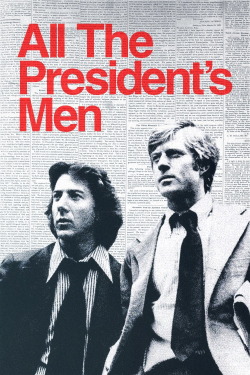
All the Presidentâ(TM)s Men is an action film. But itâ(TM)s comprised not of speeding cars, bombs, fists, gadgets, guns, but of names, dates, phones, happenstance, false leads, relentless footwork, denials, and, like a would-be usual villainous mastermind whose henchmen doggedly protect him, the truth. Just such particulars brought about Watergate and Nixonâ(TM)s resignation, but the movieâ(TM)s more about facts than consequences. Itâ(TM)s as precise about the procedures used by investigative reporters as we have any entitlement to require from a movie.
Hustling by like a whirlwind at a somewhat sprawling 138 minutes, All the Presidentâ(TM)s Men could stagger a laid-back viewer as easily as astound a researcher doing a frame-by-frame breakdown. It has a faster pulse, tighter tension than any other newspaper movie I can think of, including His Girl Friday, the ones that always exaggerate the exhilaration and discount the tedium and waiting. This oneâ(TM)s all about those and the vigorous excavating. It relies on what we already understand about Watergate to supply thrill, yet given that William Goldmanâ(TM)s screenplay is virtually all dialogue, director Alan J. Pakula has achieved extraordinary success at keeping snaredrum tension.
Who wouldâ(TM)ve thought you could mount such suspense with Bernstein approaching Woodwardâ(TM)s desk and eavesdropping on the extension phone? And the movieâ(TM)s so well acted, shot and paced that it expands the drive and energy even in the scenes where Woodward and Bernstein are getting doors shut in their faces. Maybe even especially! The sound throbs, with its suggestive bonding of typewriter keys. The cutting is shrewdly subtle, with its persistent long takes that simply make us sit and fester. Once, we from a wide shot to a medium shot of an interviewee. Weâ(TM)ve leapt forward as though leaning in to hear, because we, like the reporters, are extremely eager to listen.
Collaborating for the third time with Pakula, Gordon Willis memorably flaunts his signature darks in the presentation of Deep Throat, spying an indistinguishable figure hidden in the shadows until he lights a cigarette, the match burning momentarily in a pond of dense black. But unexpectedly, he compellingly uses vivid lights. The Washington Post offices are seen with granular white lighting that throws no shadows, leaves the lines of workspace and typewriters like a shelter of familiarity in a world of dim, treacherous corners.
This is cinemaâ(TM)s most sharp-eyed survey of working journalists weâ(TM)re ever apt to see. Woodward and Bernstein shall in the end supplant Hildy and Walter as vocation prototypes, thriving exceptionally in implying the fusion of excitement, obsession, self-doubt, and nerve that flooded the Post as they aimed at a presidency. When Robert Redford revealed that heâ(TM)d acquired the rights to the book, the newsroom gag was about reporters turning into movie stars. It ended up vice versa. Redford as Woodward and Dustin Hoffman as Bernstein drill through their characters and become completely realistic. Thereâ(TM)s not a put-on or âHollywoodâ? footnote in the entire film.
Pakula doesnâ(TM)t brood over the personal lives of the characters, but he has a fastidious feel for their professional lives, particularly with their relationships with editors. The Watergate story began as a local story, not a national one. Woodward was Protestant, Bernstein a Jew. Woodward was a Republican, Bernstein a Liberal Democrat. Woodward was an extremely didactic journalist, Bernstein had a jittery impatience. But they had to work together, be professional, objective.
We meet the metro editor, Jack Wardenâ(TM)s Rosenfeld, protecting and pestering âWoodsteinâ? as the dynamic duo came to be recognized. Martin Balsam plays Simons, the managing editor, and Jason Robards is Bradlee, the executive editor. All three are perfect. Theyâ(TM)ve learned the exact pitch, they carry on a news meeting like theyâ(TM)ve held one before, and they even demonstrate characteristic office ways: If youâ(TM)ve covered a daily beat, youâ(TM)re entitled to slacken your tie and wear saggy pants.
The movie has dozens of minor character roles for all the people who spoke to Woodstein, or declined to. Some of the other roles have a propensity for merging into one mysterious Source, but Robert Walden makes an unforgettable Donald Segretti, the dirty-tricks specialist veiling anguish with bluster. And two crucial informers are played in fascinatingly diverse ways. Jane Alexander is a bookkeeper who gives the team some of their best leads. Sheâ(TM)s readily understood, frank, nervous. Hal Holbrook, as the mystifying Deep Throat, the source within the administration, is distressingly aloof, practically like heâ(TM)s viewing the proceedings with a vain snicker.
There mustâ(TM)ve been lure to expand upon Woodward and Bernstein, alter the rhythm with subplots about their personal lives, but, like all good action-adventures, the film sticks resolutely to the chase, starting with an apparently minor break-in and following it, almost disbelievingly sometimes, as it ultimately runs all the way up the ladder. The energy of Watergate seems to thrust Woodward and Bernstein, rather than vice versa, just as the ticking bomb or the hostages in the skyscraper do John McClaine or James Bond.
This review of All the President's Men (1976) was written by Paul Z on 17 May 2011.
All the President's Men has generally received very positive reviews.
Was this review helpful?