Review of All Is Lost (2013) by Harry W — 12 Mar 2014
I only found out about All is Lost after seeing it nominated for several awards at the Golden Globes, but the fact that legendary actor Robert Redford put himself in such a physically demanding role is more than enough for me to want to see it.
I went through most of 2013 thinking that it was a very dreary cinematic year because I had seen two films I deemed the worst films ever made which were The Great Gatsby and A Good Day to Die Hard, yet I had not seen a film I deemed to be one of the greatest I had ever seen. All of that changed when I saw All is Lost.
All is Lost is simply one of the greatest movies ever made and most definitely the greatest movie of 2013.
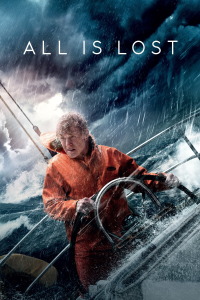
One thing I love about All is Lost is the storytelling in it. A lot of the lost at sea film such as Cast Away or Life of Pi focus in reminding is why it is important for the characters to return to land and give us a background story. In All is Lost, we are told nothing. The story starts when Robert Redford's boat hits a shipping container which causes a large whole in the side of the boat and is the source of a flood which damages his boat and some of his equipment. We have no idea who the protagonist is, simply that he is a man out at sea. We learn small aspects of who he is from what he does, not from anything he says. We learn quickly that he is a confident and sensible sailor who is prepared to face the situation thrown at him through simple logic. And he's not some kind of young and muscular action hero, he is just a man with a man's courage. There is no way to determine what his career is, why he's out at sea or where he is going. We know simply that he is just a man out on the ocean, and so with that aspect in mind we can only wait to see what happens next.
The film tells you nothing about who Robert Redford's character is. For all we know he could have been sailing to visit his family or he could have been a serial killer on the run. But I doesn't matter, because in the end the reason we want him to survive is because he is a human and every human has right to live. That's the kind of realisation that All is Lost gives you. And that's how it touches you, because All is Lost has a character you can't judge for his personality, it simply has a man with an instinct to survive. It strips him down to the core of his humanity and has audience bare witness to his instincts and what intelligence he has, so the film is a very humane one with a single character. An unnamed hero, a man, and a human being,.
All is Lost has so much intensity in its atmosphere that it's one of the most thrilling films I have ever seen in my life. The intensity comes from a range of things, but none other than from the audience's natural instinct to determine what is going to happen next and inability guess it.
At the end of every scene, there is an ambiguity left. There is no way to determine what comes next, and that actually left me very scared. I was in fear almost the whole time in All is Lost because of its unpredictability. I was scared about what would happen to the protagonist, but I was more scared of when the film was going to end. The film opens with the protagonist dictating that "All is Lost" and so there is no way to tell when things will end. At the end of every scene I was scared the movie could be over because of the clever direction that J.C. Chandor gives to All is Lost. There is a scene which subtly tells the audience that the protagonist has reached the phase of his adventure where all is finally lost, and it's told simply by the look on Robert Redford's face and the musical score. When I realised that all is lost for him, I cried. I couldn't stop, I just let everything out. Like the protagonist, I had been strong for so long but when he realised that his chances of survival were gone, he just took it all in without making it too obvious. This was the point where I realised that I had connected to the protagonist. I had become so compellingly caring of him and wanting for his survival that the idea that he couldn't survive made me cry. A lot of the time with films like this, you can tell that the protagonist is going to survive in the end, but with All is Lost you cannot be sure. The title suggests that he may not, and the opening scene suggests that the audience could be about to watch a film that leads a man on is meaningless attempts to survive which ultimately led to his untimely death. There is not a way to figure out what route All is Lost will take, but it surpasses the quality of films like both Life of Pi and Cast Away solely on the basis of its unpredictability. Films like both of those characterise their protagonists as being heroes through giving them backgrounds and intentions, and that gives an edge to the film which leaves it with a hint of predictability. In All is Lost, it starts out at sea and the only intention of the main character we learn about is his instinct to survive. The only other things about him are found out by his interactions with the world. So All is Lost serves as one of the most simple yet exceptionally intelligent examples of storytelling I had ever seen.
From a technical standpoint, All is Lost is completely unforgettable, and the simple fact that J.C. Chandor achieved so much on a budget of a meagre $8.5 million is simply incredible, almost unbelievable.
I believed for most of the film that the entire feature had been shot on location in the ocean, and it wasn't until I saw sea life come along that I figured some visual effects were in use. I didn't think that on a budget of a meagre $8.5 million that visual effects of that quality were available because it took $120 million to produce the awful romantic comedy How Do You Know?, so the fact that a film with a budget of more than 14 times less than that would create such a flawlessly believable universe throws my entire view of Hollywood cinema into mystery. I guess that money has to go to a large crew, big name actors and advertising whereas All is Lost features a relatively small crew with most of the work done by J.C. Chandor and Robert Redford, as well as the film's producers and the rest of the relatively small crew. All is Lost reminds us of the simplicity of good filmmaking, and how while making a film may be hard as the production of All is Lost was said to be, it's about doing a job with skill instead of doing it with money. J.C. Chandor does something that many modern filmmakers forget to do, and he deserves immense praise for it.
The cinematography in All is Lost is excellent. It's always perfect in capturing the mood of being on a boat or life-raft by keeping things clearly visual as well as shaky enough. They even show what the protagonist sees from a perfect perspective. So it's easy to feel like you are there with Robert Redford in all is lost, and all the footage is edited at a perfect pace.
All is Lost is a film notable for the quality of its sound effects. As I sat in the cinema watching the feature, I heard the dripping sounds of water all around me and it made the experience feel all the more real. The sounds came from every direction, and as the film featured almost no dialogue they were of key importance. The sound was one of the most important aspects in All is Lost as they tell more about the story than language ever could. The sound effects hit viewers in the face and you would never see it coming, so they provide a key intense source of the thrills in All is Lost. I've never seen a film where talking is replaced by natural sound, and All is Lost shows just how to make such an idea work and do it so well. It achieves with sound effects what a lot of films require a musical score to do, and while there is an effective musical score which is used at perfect moments without having the film reliant on it to relate the atmosphere to the viewer much. At times the musical score can hit the viewer and create an emotional experience, but it's a simple score which is only ever used lightly yet effectively. So from an auditory perspective, All is Lost is a hell of an experience.
Really, All is Lost is similar to the critically acclaimed science fiction drama of the same year Gravity, but set in the ocean instead of space. While Gravity is perhaps more thrilling from a technical perspective because you're never going to find another rocket to come and save your life in time, or enough supplies to give you a decent length life-span, All is Lost is superior from an emotional perspective. The protagonist has nobody to talk to and nothing to say, and while Gravity has something happening in every scene, All is Lost sometimes leaves some waiting around to happen, because that's what the nature of surviving at sea is. In space it's about action, on the sea it's about acting as well as waiting. And I was more scared by All is Lost because it is arguably more likely that I'm going to get lost at sea than lost in space. While Gravity takes on a new concept, All is Lost takes on a pre-explored concept and takes an entirely new look at it. And the look is incredibly powerful thanks to J.C. Chandor's best direction. I'm not surprised that Gravity swept the Academy Awards for so many awards, but I feel that All is Lost was snubbed from many of them. At least it got a nomination for Best Sound Editing, as well as a Golden Globe Nomination for Robert Redford's performance and a win for its musical score.
Robert Redford's performance is arguably his greatest to date. His role is obviously his most physically demanding of his career because it requires him to say around 20 words scattered over a period of 106 minutes while replacing his usual clever and sophisticated line delivery with a lot of physical movements and facial gestures to determine the nature of his character and mood. Yet he rarely lets the fact that he is 77 get to him, because he has the determined strength of a young man facing the challenge and the wisdom of a man who has fought through one all before. When we see Robert Redford eat we see a certain frailty to him which reminds us of his age, and in actuality it makes the entire feature more inspiring. Because a 77 year old man fighting the battle of the ocean is one of the most inspiring aspects of the film. It's enough that he is an inspiring man fighting the greatest battle of his life, but doing it at age 77 inspires viewers and reminds us that age is just a number in a time of crisis. Instead of thinking "Well I've lived a long life and now I can die in peace" he decides to prove himself, almost like Santiago from The Old Man and the Sea. It took reviewing this film for me to make a notable comparison between the film and the classic Ernest Hemingway novel, and it is solely thanks to the presence of him that it is notable. His performance is a career greatest, where he dedicates the greatest physical acting available to him to his performance, combining unflinching facial gestures with the strongest physical actions that look like they're packed with the kind of adrenaline that would only come to you if you were actually in this situation. Robert Redford puts flawless realism into his role in the nameless protagonist of the story, and even when he says a few words they make a powerful impact. Robert Redford is a true hero in All is Lost, and frankly I have never had more respect for him as an actor than I have after seeing him in All is Lost.
So All is Lost is an unforgettable feature. It has a lot of flawless technical qualities which make it an amazing visual experience, and thanks to career best direction from J.C. Chandor and a career greatest performance from Robert Redford it is undoubtedly one of the most amazing films I have ever seen, and I repeat my idea that it is the single greatest film of 2013 in what was a largely dreary cinematic year.
This review of All Is Lost (2013) was written by Harry W on 12 Mar 2014.
All Is Lost has generally received positive reviews.
Was this review helpful?