Review of All About Eve (1950) by Toshihiro K — 27 Jan 2009
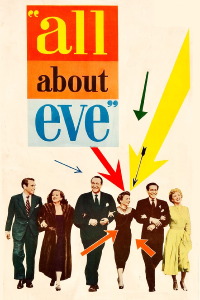
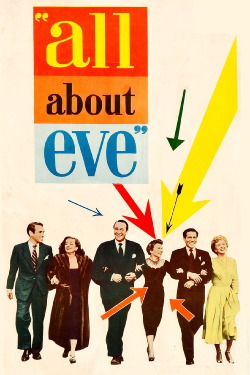
With extravagant images that ornament the atmosphere of the ceremony as well as the celebrities in their extravagant dresses, Eve Harrington (Anne Baxter) appears in the center of the applause with the award in her hands. She was a na�¯ve yet rapacious actress with youth and ambition, as opposed to Margo Channing (Bette Davis), who appears in the middle of the room and is considered a âtrue actressâ in her fortieth. Eveâs first appearance in this scene is only in few frames, yet the anticipation of the conflict and the sense of bitterness between the two actresses can be sensed to a great extent. The fact is that this is the story about Margo, who is in the critical phase of her career due to her age, and her struggle in defining her true quality, which accelerates and reaches to the saturation point. The contrast between the eyes of the others and Margoâs own paranoia of a beauty in a public appearance, which she has inevitably developed throughout her career, is the directorâs general concern of a life of an actress. It is a revelation of the social inequality among those who is subjected to sex-appeal, and Margoâs sense of selflessness is on the verge of destruction. With all the quality that Margo has lost in the past, Eve comes to challenge Margo, tries to imitate her charisma, and when Eveâs deception and manipulation come to the surface, the story reveals the ugliness and creepiness that persists in the industry. Yet beyond the general statement of social inquiry, with the directorâs ingenious of storytelling and his respect toward the performance, All About Eve posits a universal concern of human condition and questions us the nature of human being, in terms of life, theater, and acting.
The first appearance of Eve barely indicates her true nature; she is just a one of the girls who is drawn into the theater, waiting to see her icon, dreaming of the spotlight in which she will appears someday. In the cold night of New York, when Margoâs one of plays is done, unlike others fan who gather around the entrance of the theater, Eve manages to see Margo. Eveâs appearance is nothing but ordinary: in a trench coat and a plain hat. Her smile with delight, when she sneaks into the set from offstage, is what the audience would expect them to do in the same situation. It is the stage that she has dreamt of, with the legendary actress besides her. In other words, Eve is the eyes of the audience, through which the life of the theater people is learned and contemplated. In the middle of the story, however, when Eveâs true intention of taking over Margoâs status is unveiled, the story shifts into another dimension: Margoâs uncertainty of her own life, a wander of self-identity and her want. She is the one who achieves the highest rewards in her career and is lost in her own achievement at the same time. The life of lavishness with a fur coat and a glass of martini, at the party of the celebrities and movie stars, which is filled with the perfume called success, is a phenomenon that never cedes away. And the people who appear in the scene are equally lonely and empty. After all, it is the life of competition and survival that lies on the other side of the coin and the incapability of loving and being loved is the decease that prevails.
What it seems to be extravagant in the beginning turns out to be the emptiness that creeps underneath their lives of profession. Then the audience suddenly realizes that Margo is nothing but an individual who deals with the pain of life and suffers from the expectation of the others. The only difference is that Margoâs life is a bit more demanding and competitive. Yet it is s a sort of an image that our society inevitably project throughout the history, with the tails of rise and fall, and Margoâs sense of loveless and self-pity is not a coincidence but a definitive reality that can be seen around every corner of the street. And the implication of the ending, that in the images of kaleidoscope there are infinity numbers of young generation who is always behind in an attempt to take over the legacy of the star, indicates that the story of All About Eve will never come to end.
Then what could be laid beyond the mirror?
All About Eve is a made of the bloodstream of the creators. It is the byproduct of the hard work, tremendous amount of love, honesty, and passion of their profession that adds the beauty to the final cut. Unlike Orson Wellâs Citizen Kane or Billy Wilderâs Sunset Boulevard, All About Eve doesnât work the same vein, in terms of visual orientation. Rather that, it is Mankiewczâs words that bounds the characters with the story, like a lush string arrangement that flows slowly and gently with a bit of sentimental and nostalgia, and making a sense of harmony within the story going back and forth. Then Bette Davisâ brilliant performance as well as Anne Baxterâs portrait of an amateur actress, Gary Merrillâs theater director, Hugh Marlowe as a playwright and Celeste Holm as his wife appears on the screen with all the elements, such as the deliberation of the dialogue, a slight gesture on their appearance, and the improvising deepen the scenes. None of the characters stand out exceedingly; each of the characters is developed with great care of characterization thus equally appears to be alive and charming.
Through the voice of the character, Mankiewicz delivers his philosophical view of general relationship between a life and a theater; he states that âwherever thereâs magic and make-believable and an audience, there is a theater.â All About Eve is a Mankiewczâs own play. Then the audience soon realizes that they are the last piece of the story: a theater doesnât exist without an audience, and it is the audience that finalizes the film. And ultimately, Mankiewicz suggests that we equally go through the part of All About Eve; a life is also a play, in which each of us is given roles, and we perfume own roles on the stage called life.
This review of All About Eve (1950) was written by Toshihiro K on 27 Jan 2009.
All About Eve has generally received very positive reviews.
Was this review helpful?