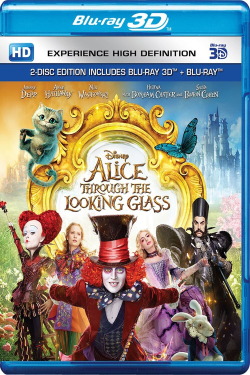
Review of Alice Through the Looking Glass (2016) by Audric E — 02 Nov 2016
Though Alice in Wonderland (2010) was a mildly entertaining experience at best, with its sequel featuring a prominent role from Sacha Baron Cohen I knew there was something more lying in wait.
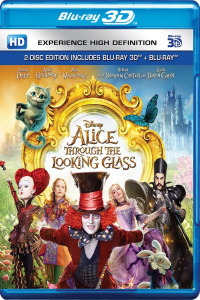
Alice Through the Looking Glass begins in the same manner as its predecessor: Alice ___ is living an unsatisfactory life outside of Wonderland and must return to the place of fantasy so that she may escape from it all. Of course, it is no matter of importance what is going on outside of Wonderland because it has no overall relevance to the story and is simply a tedious attempt at character building. Unfortunately, it also foreshadows an entire film that pretends it has the dramatic ground to actually do that, all while repeatedly making use of the word "time" to hint of its greater significance in the later story.
The characters in Alice Through the Looking Glass are a severe weak point for the narrative. The film is focused so much on spectacle that it doesn't concern itself much with actually trying to make compelling characters. The script relies on cliche dramatic plot points to do this, and the plot structure makes it worse. Through its time-travel narrative, audiences are frantically rushed through a thin story that cuts between numerous points in time and depicts the occurrences that form the characters into who they have become in the modern day. Every little plot point is one that audiences have seen in countless other films, and director James Bobin doesn't even attempt to offer any actual development for them. It's annoying enough that the protagonist's reckless disregard for life puts the entire universe in danger and the repeated ploys for her to consider the damage of her actions are ignored due to her own adventurous desires. But with the tedious sisterly conflict between Mirana of Marmoreal and Iracebeth of Crims and the pathetic backstory for the Mad Hatter Tarrant Hightopp thrown into the equation, the experience ends up completely bereft of compelling drama. The only character I felt anything for was Time because his way of life is consistently threatened by both the heroes and villains of the story, but since he is just one character in a world of many there are only selective moments to really enjoy his presence. Everyone else just burdens the experience due to a lack of development or likability, and the way their individual stories are thrown into the narrative with a segmented structure interferes with the path of the story. And amid it all, the internal logic of the time-travel narrative is very inconsistent and convoluted simply because the script only cares enough to use it as a gimmick rather than for any compelling reason whatsoever. Alice Through the Looking Glass carries different story flaws to its predecessor, but it ends up being just as one-dimensional and even more predictable this time around due to an absence of the originality that the first film tried for.
When Alice first crosses through the mirror that will return her to Wonderland, she immediately wanders into a world of obvious green screen effects before turning into a walking piece of CGI and interacting with non-present characters that she cannot lock eye focus with. This wears off in time and the universe becomes more believable, but soon enough audiences realize that they are in for much of the same imagery that they have already seen. The central reason I watched Alice Through the Looking Glass was because the big-budget spectacle of its predecessor gave me hopes of experiencing another feature of visual marvel. Unfortunately, repeating the mistakes of Alice in Wonderland with an extremely daft story is not its only repetition issue. The imagery in Wonderland has all been seen before, and though strong fans of the first film may love to see the sight of Tim Burton's creations once again, it's all been done before. Wonderland is no longer the same innovative pleasure to look at. The dedication of the team in charge of the production design and costumes work to ensure that the universe is colourfully detailed and believable which is a feat that is most certainly succeeds in achieving. But it's already done that once, and the second time it is far less impressive.
However, when Alice enters the realm of time the film takes a turn for the better because the visuals completely change style. Rather than the same fantasy that viewers are accustomed to by this point, Alice Through the Looking Glass embraces a more steampunk style. It remains dominated by computer-generated imagery during these scenes, but the sight of all the mechanical workings of Time's palace with brilliant detail and a grim colour scheme is quite pleasing to look at. The contrasting colour scheme to the more light-toned moments in the film creates the sparks of magical wonder that audiences will have come for. And though the same cannot be said for Alice's trip through time being depicted as at flight across the ocean, there is nevertheless a sense of sporadic enjoyment that comes from the steampunk moments of Alice Through the Looking Glass. Danny Elfman's musical score also helps the film in its atmospheric ambitions.
When it gets down to the acting in the film, the cast of Alice in Wonderland rarely make any kind of an impact. There is no doubt that a talented collection of versatile actors certainly prove appropriately cast in their roles. It's just that we've already seen it all before and there is nothing new that they add to the characters this time around.
Mia Wasikowska makes a believable protagonist hero but once again it is hard to believe that she is actually playing Alice since the character has been turned into a very generic adventure hero with a melodramatic approach to everything. And Helena Bonham Carter's antagonistic nature is no longer as impressive or believable, making it all the worse when there is a sudden deux ex machina that turns her good once again at the end of the story. Anne Hathaway doesn't do much either as her likable charm is very repetitive until the story's end where she finally puts some actual heart into the performance. Matt Lucas' comic charms are still enjoyable, but he offers no actual relevance to the story.
But no cast member is more frustrating to watch than Johnny Depp. Johnny Depp's return to the role of the Mad Hatter stands alongside Mortdecai (2015) as one of the biggest downfalls of his career. Though Johnny Depp has proven he still has the power to really impress with his performance as James "Whitey" Bulger in Black Mass (2015), Alice Through the Looking Glass highlights that his status as a walking costume collection is no longer as charming as it once was. Since the Mad Hatter is essentially the dramatic core of the story, its depressing to watch Johnny Depp falter so much. Admittedly it isn't all his fault because the writing is completely inappropriate for the character when he's a one-dimensional comic character with a lisp, but seeing him actually try to maintain this exact nature while dealing with darker dramatic material is just so wrong. The actor offers no reason why we should care about him since his attempts at creating sentimental drama barely even reach surface level, and his attempts to do so prevent him from ever trying to really make audiences laugh. Johnny Depp is so inconsistent in tone that he cannot develop his character in any direction with Alice Through the Looking Glass, and it shows that the man is now way past his prime as a performer.
Sacha Baron Cohen is the one consistently innovative thing about Alice Through the Looking Glass. Proving himself to be the chameleonic talent that Johnny Depp once was, Sacha Baron Cohen steps into the costume of a very strange and elusive character only to shine with maximum charisma. He is appropriately over the top with his comedic virtues, intimidating with his unpredictably dark nature and likable due to his vulnerabilities. He is the most developed character in the entire film simply because Sacha Baron Cohen shows so many sides to him and ensures that they integrate appropriately into the one character with a natural flow. Sacha Baron Cohen throws himself into the manic universe of Alice Through the Looking Glass and makes himself a dominant presence with active magical talent, creating an impressive testament to his magnificent talents as a performer.
Alice Through the Looking Class works as an occasional showcase for the brilliant talents of Sacha Baron Cohen, but with such a listless and cliche story surrounded by overly familiar visuals and performances, there is little wonder to experience.
This review of Alice Through the Looking Glass (2016) was written by Audric E on 02 Nov 2016.
Alice Through the Looking Glass has generally received mixed reviews.
Was this review helpful?