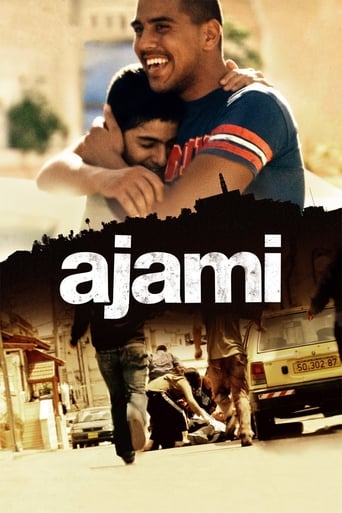
Review of Ajami (2009) by Davey M — 02 Mar 2011
A fifteen-year-old boy kneels in the dusty street of Tel Aviv, working on his car. A static wide shotâ??two riders quietly appear in the foreground on a motorcycle, ride past, and, mistaking him for someone else, they shoot the boy to death.
The unexpectedness and arbitrariness of violence is a theme that runs throughout Ajami, the 2009 Academy Award-nominated crime drama from Israelâ??it is also a stylistic motif. After this abrupt opening (several more bloody shootings follow in the brief pre-credit sequence), every shot of a vehicle riding into frame fills the viewer with a certain uneasy dread. But though there will be many more deaths to come, thereâ??s never another drivebyâ??and, without the release of expected gunfire, the dangerous tension is allowed to escalate. Ajami is a film about violence that cannot be entirely avoided because it cannot be sufficiently explained. The characters are Muslim, Jewish, and Christian, and yet most of the deaths result not from clashing ideologies, but from that great staple of classical tragedyâ??misunderstanding.
Ajami follows a diverse group of characters through a series of interlocking stories (the film is divided into chapters and jumps about chronologicallyâ??the result feels something like an Inarritu film by way of Pulp Fiction). At the heart of the story is Omar, the nineteen-year-old the cyclists had intended to kill in their vendetta for a crime Omar himself did not commitâ??his uncle shot a man who came into his diner wielding a gun. In one of the filmâ??s early chapters, the two families argue in front of the judgeâ??was it murder? Self defense? The judge doesnâ??t want to get involved and, after settling a debt for Omarâ??s family, he passes judgment off to Godâ??and, though a settlement has been reached, no peace has been made by the time the meeting ends. Though the filmmakers deftly avoid any heavy-handed political allegory, the implications are certainly there for those willing to look.
Omar, a Muslim, is carrying on a forbidden love affair with Hadir, a young Christian, whose father is trying to smooth things over for Omar and his family. A friend of Omarâ??s, Binj, is rejected by his community for carrying on with a Jewish girl. Melek, an illegal Palestinian worker, is desperate to get money for his motherâ??s operationâ??even if it means becoming a drug dealer. Dando, an Israeli policeman, tries to find his missing brother. Each of these characters form the focus of one of the filmâ??s chapters, and each of their stories bleeds into one another in a jumbled chronology thatâ??s hard to articulate, but surprisingly coherent in the context of the filmâ??we have a sense of where we are, even if weâ??d be hard-pressed to actually explain it. All the stories come spilling together into a climax that manages to arrive with cloud-gathering, punch-in-the-gut inevitability even as it subverts our expectations.
As powerful as the film itself is the story behind the film. Ajami was co-written and co-directed by Scandar Copti (who also appears in front of the camera as Binj), an Israeli Palestinian, and Yaron Shani, an Israeli Jewâ??all of its stars are non-actors who went through a yearâ??s worth of improvisation and workshopping to come up with the eventual script. The resulting authenticity lifts Ajami above many of the films it so closely resembles (Crash, Babel, etc.), and the story of the filmmakersâ?? cross-cultural bridge-building adds a quietly inspirational meta-narrative to the grim proceedings of the plot. The characters in Ajami are doomed by circumstances and subjectivityâ??victims of missed connections and miscommunication. They are doomed for not knowing the whole story. But, as Shani and Copiâ??s collaboration demonstrates, if tragedy is to be avoided it is through coming together in open dialogue. Such a simple solution to such a major world problem may not be entirely insufficient, and it is certainly not new, but there is power in itâ??and it may be the only hope.
This review of Ajami (2009) was written by Davey M on 02 Mar 2011.
Ajami has generally received very positive reviews.
Was this review helpful?