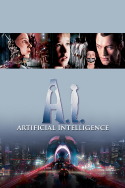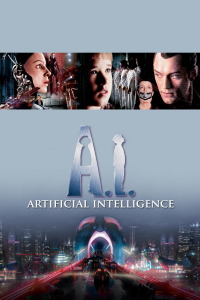
Review of A.I. Artificial Intelligence (2001) by Jacob F — 16 Jun 2011
Boy oh boy. A.I. Artificial Intelligence is one of those wonderfully tangled and deeply-rooted pictures that's ripe for a full-length book examination of not only its history as a film project but, far more important, its viability as an absorbing and thorough look at humanity and what it means to be human, the picture delving into some heavy psychological and philosophical overtones that succinctly run the gamut of human emotions, ultimately laying its cards on the table and identifying what it is the film believes that makes a human being, or an entity striving to become a human being, human: the ability to believe. That ability to believe in something, the film posits, surpasses even collections of electronic impulses, the ability to walk and talk, the ability to think, the ability to reason, and the ability to demonstrate creativity. A.I. Artificial Intelligence is a sometimes moving and occasionally exciting picture that works almost exclusively through its exploration of ideas of great moral, emotional, spiritual, and philosophical import morphed into a story and presented on a screen. The characters are secondary to a plot that's constructed around a journey towards discovery, one robotic child's endeavor to surpass the limitations of even its advanced circuitry, programming, and artificial flesh in search of that one final ingredient that will make it wholly human. What that missing element may or many not be is secondary to the boy's drive to find it. That's what sets A.I. apart from the crowd; the film looks at the soul from a different direction, positing that it's not necessarily having a soul but instead harboring the desire to find one that truly makes something human, no matter how it may be constructed or where it came from.
In the future, the world has been ravaged by the consequences of global warming. The polar ice caps have melted and destroyed coastal cities all over the world. The population has dwindled, and pregnancy has become a privilege, not a right; the government has imposed licenses for having children. With the rise of the waters came a rise in the demand for artificial life, robots that would work tirelessly yet consume few of the remaining precious resources. In fact, science is on the verge of creating a robot so advanced that it can give and receive love as would a child dedicated to its own biological mother and father, a wondrous breakthrough in an era when bearing children is more difficult than ever before. When the parents of a sickly child surviving in stasis agree to adopt one of these new robotic miracles of science dubbed "David" (Haley Joel Osment, Secondhand Lions), they welcome it into their home and hearts, but with their own prejudices and reservations. Father Henry (Sam Robards) and mother Monica (Frances O'Connor) ultimately make David their own, but when their sickly biological son Martin (Jake Thomas) is miraculously cured and able to return home, a sibling rivalry ensues that has dire consequences for the entire family. Ultimately, the mechanical David is discarded and left to fend for itself, seeking only to become human in hopes that its imprinted mother will take it back and once again love it and allow it to love her, just as it's been programmed to do.
A.I. Artificial Intelligence is a disturbingly creepy and downright frightening, at times, look at what to humanity when humanity removes humanity from part of its own equation. At least it begins that way. A.I. takes a turn towards the oddball surreal in a second act- the film's only real weak point - that plays a center entity designed, it seems, without thematic story building in mind and existing solely to bridge the gap between the first and third acts, the former introducing the concept of the removal of humanity from the equation, the third the effort to reintroduce it, and from a being that doesn't have it and never possessed it to begin with. What a beautiful conundrum that is. Still, A.I. Artificial Intelligence works best in its first act; whether it's that it never recovers from a completely out-of-place second act or that there's just more of an opportunity for a deep philosophical study by the material as it is represented in the first act is up for debate, but it's that question of artificially recreating humanity and the well-meaning but, it would seem, misplaced notion that both the natural and synthetic can co-exist by trying to make one into the other that's the real highlight of Director Steven Spielberg's (Minority Report) thought-provoking picture. The effort to build emotion into an emotionless being and expect emotional people to accept an artificially emotional robot as a real-feeling entity presents quite the human paradox: what is love, and what is it that loves, both on the giving and receiving end? Certainly, man can love inanimate objects or even living beings that don't possess souls as man understands that concept, but even that form of love differs from the ultimate definition of love between a man and wife, a father and son, a mother and daughter, and the like. But when it comes to a man giving love to something artificial, he understands it to be a one-way street; what happens when he expects to receive love in return from a "life" where life does not exist, only the artificial semblance of life given to it by other men who neither know nor love the people the inanimate object will ultimately attempt to artificially love? It seems as if the real lesson here is that real familial love is not something that can be welded together in a machine shop or downloaded onto a hard drive, no matter how advanced the programming may be.
Then there is the film's other story, the other side of the coin, David's quest to become a human boy. What drives David to conclude that his lack of humanity is his one true fault? Is it his experiences in life, the culmination of his own personal journey towards becoming an evolved sentient being, or is it simply his programming? David seems to lack the understanding necessary to realize that even the limits of biology cannot be overcome by even the very science that created him. David cannot understand the differences - as drastic or as subtle as they may be - between being aware that he's not human and accepting his limitations as an artificial life form. His programming that commands him to love and be loved is so all-encompassing in his existence that when he hears the story of Pinocchio - the wooden doll that became a real boy - his circuitry cannot recognize the difference between reality and fantasy in his quest to satisfy the parameters of his programming, as evidenced by his belief in the physical embodiment of a fictional fairy tale character and its ability to turn him into a real human being. It's interesting to compare and contrast two of fiction's most famous robots/androids - whichever term best fits them - A.I. Artificial Intelligence's David and Star Trek's Data. Data's programming was constructed around the deliberate absence of emotion; he cannot love, nor can he feel whatever love others may bestow upon him. He strives to be more human but innately understands that he can only strive and never achieve. His goal is to become as close to human as possible while still accepting his natural limits as an android. David, on the other hand, was built only with emotion in mind. Constructed to love and be loved, David's quest to become human is only an extension of his programming, a subroutine that, rightly or wrongly, put two and two together and led him to believe that only becoming human could fulfill his created purpose. Unlike Data, David does not want to become more human or completely human to better himself; he does so only out of an artificial sense of duty, a false knee-jerk reaction emotion that took hold of him when real human emotion and his own programmed understanding of that same emotion both failed him. David's love is only imprinted upon him; it's a failed digital recreation of the most basic yet certainly most complex of all human emotions, one that is felt, learned, and accepted only through the passage of time and the processing of other emotions both similar to and varying from it that all come together to create a unique human understanding that's different for every individual and not simply forced upon them with no prior experiences or emotions on which to build them on and compare them to.
Looked at from a more generic technical perspective, A.I. Artificial Intelligence is a success, but it's not up to the quality the story commands. The checkered history of the project is well-documented; based on a story by Brian Aldiss entitled Super-Toys Last All Summer Long, the filmed adaptation was relegated to the back-burner for many years with Director Stanley Kubrick's (2001: A Space Odyssey) name attached to it. Still, the legendary director worked closely and tirelessly on the picture long before it went into production, but seeing that the project hovered in limbo for more than two decades, visionary filmmaker Steven Spielberg took the reigns after Kubrick's death. The film was finally put into production for a 2001 release at a time when computer-aided visuals were advanced to the point that they could carry the film's necessary effects-heavy elements. Perhaps more crucial than any other factor was the emergence of young Actor Haley Joel Osment who, hot off of his success in The Sixth Sense, was seen as a viable human actor not only to play the film's lead part, but to practically become the emotionally confused artificial life form David. Osment's performance is extraordinary; he captures with a palpable ease the simplicity of the character but also the depth that surfaces as the film moves along and David's journey evolves. The young actor meshes David's determination and naivete extraordinarily well, the performance defining the film from a technical perspective, even surpassing Steven Spielberg's admittedly wonderful handiwork. Spielberg's vision and style for the picture is a great aid, particularly through the critical first act; he uses skewed perspective and unique camera shots with regularity to help capture and establish the social and emotional awkwardness of the story. Perhaps the film's finest shot - and one that can be seen as something of a foreshadow - is the one in which David is introduced on-screen. His figure is terribly blurred and misshaped, appearing as if an alien, an apt descriptor for something different, an unknown, something never before seen or experienced. Spielberg is the undisputed master of creating and maintaining his own unique worlds and shaping his audience's perspectives through visual cues; while his second act is awkward at best and the third thematically meaningful but structurally built on unstable ground, the film works on the strength of its first act, the performance of its lead, and the weight of the whole of the story.
What a fascinating slice of cinema. A.I. Artificial Intelligence is a wonderfully conceived and highly thought-provoking film with the execution to match, at least in the first act and, at times, the third. The story examines what happens when humanity tries to remove itself from the equation; that the end result of that endeavor that lacks humanity only wants to find its one missing element is a wonderfully engaging premise. The film explores the search for life where it does not and cannot exist, but it also suggests that maybe it's not the soul, but the recognition of its absence and the resultant sense of purpose and the quest to find it that really makes something "human." Steven Spielberg handles the story proper expertly; there's no telling what the film might have looked like in Stanley Kubrick's hands - maybe it would have bridged the bookend acts a bit better - but as it stands, A.I. Artificial Intelligence is more of a success of thought-provoking concept than anything else. The film certainly manages to engage its audiences through the story and characters, but they are ultimately just vessels upon which the story boards and travels to its various destinations along the line that takes viewers through life as it is seen in both the prisms of the absence of and search for humanity. A perfect film for a philosophy, psychology, film, or even maybe a religion class, A.I. Artificial Intelligence may not be a masterwork of cinema, but its story is certainly a masterwork of the mentally challenging type.
This review of A.I. Artificial Intelligence (2001) was written by Jacob F on 16 Jun 2011.
A.I. Artificial Intelligence has generally received positive reviews.
Was this review helpful?