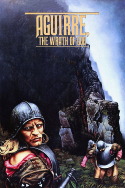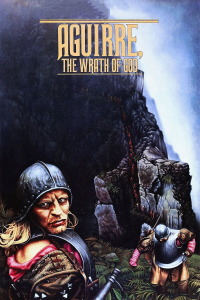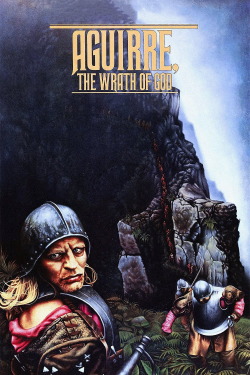
Review of Aguirre, the Wrath of God (1972) by Craig B — 15 Jul 2008
The main problem for Aguirre, the Wrath of God (1979) is it fails to live up the story of its creation. Near legendary is the insanity of its star Klaus Kinski, a man so insane he spent five years in self imposed isolation writing and saying the F-word every five seconds. Director Werner Herzog also casts a big shadow over his own film. Herzog famously threw himself into a patch cactus plants to amuse a group of dwarf actors, and has managed to get himself shot twice, once in South America by guerrilla insurgence whilst crossing a river and latter during an interview with Mark Commode for the BBC, apparently a resident was upset by the noise level.
Further distracting from the picture is the story of its makers. Shot deep in the rain forest of South America the production was highly troubled. Cast and crew had to flee when attacked by tribesmen, and the rafts used during production sank. Tribesmen working on the film offered to kill Kinski for director Herzog, who politely declined. Lastly Herzog only managed to get Kinski to finish the film by pointing a gun at him.
Such legends swallow this slow moving film about futility. Kinski stars as conquistador Don Lope de Aguirre who leads a doomed river journey to find El Dorado. After separating and mutinying from the larger part of the expedition Aguirre ends up leading 40 and only two women, one of which is his daughter, to start a new kingdom. The mutineers are all grossly deluded and do increasingly bizarre actions, electing a new Emperor, writing a letter they have no way of sending to the King of Spain informing him they have picked a new Emperor and putting on trial their old leader. The films theme of futility and delusion is firmly established.
But, the film is not just a one trick pony. Other themes covered are existentialism and the nature of delusion. Also covered is the notion of leadership which adds an interesting layer to this German production. Film school students will have hours of work writing essays and thesis on the Aguirre.
The journey down river bears more than a passing similarity to Apocalypse Now (1979) without the helicopters or the book Heart of Darkness by Joseph Conrad. Similarly Aguirre has long periods of boat time interspersed with encounters along the river. Things get increasingly strange which includes the members of the expedition themselves. The difference though is that Aguirres journey has no end. The film finishes with our anti-hero babbling delusions to himself with no one to hear him except the spider monkeys which inhabit his raft.
Despite his legendary status as insane and insanely good at acting Kinski has little to do in the film except look intensely insane. Certainly he has that ability down to perfection, but does not very his performance an iota during the whole film. He actually has very few lines until the end but when he delivers them it certainly captures the moment. The rest of the cast are character actors who play their performances solidly. Standing out is the expeditions priest and also our narrator, who is decidedly cynical following whoever is in power.
Herzogâ??s direction is tight and concise rather than imaginative, managing to capture the claustrophobia of the rafts and also the vastness of the river. He also adds some strangely dark humour to the film and indeed the film as a whole can be treated as a very dark comedy.
Watch the film if you want an intelligent film with a bit of philosophy. By the word philosophy this film is not a crowd pleaser or an action piece. The pace is slow and deliberate which helps with the sense of futility. Just donâ??t expect any of the hype about the cast or the films making to be on screen.
This review of Aguirre, the Wrath of God (1972) was written by Craig B on 15 Jul 2008.
Aguirre, the Wrath of God has generally received very positive reviews.
Was this review helpful?