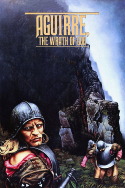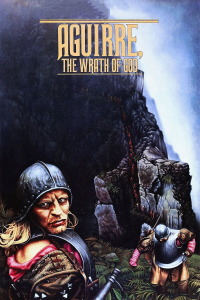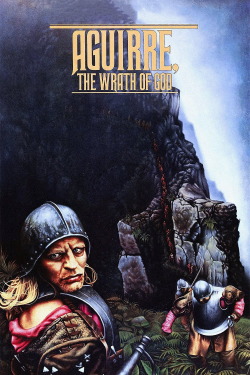
Review of Aguirre, the Wrath of God (1972) by Simeon D — 12 Mar 2010
What was Werner Herzog on when he made this film? Weed? Crack? Cocaine? LSD? Shrooms? Heroin? LSD? Acid? Cough Medicine? LSD? If you haven't gotten my point already, this is an incredible vivid, slow going, trippy movie. In ATWOG, we follow a rebellious group of conquistadors, lead by the cold hearted Aguirre, who is spectacularly played by Klaus Kinski, as they search relentlessly for the fabled city of El Dorado. Herzog seems to have created a theme that recurs in many of his films, which is that following a dream or aspiration with too much greed can cause your inevitable downfall. This theme perfectly plays out in this film, because as the story progresses, we find ourselves despising Aguirre more and more, and seeing him fall to ruins becomes a delightful treat. But, that being said, Aguirre's story is only the final third of the film, the rest is more a historical reenactment. The first third is about a larger group being sent out by a powerful Spanish politician to find El Dorado, and the second third is about the rebellion and take-over of Aguirre and his followers. At times, this can become incredibly slow going, but Klaus Kinski's performance and the vivid imagery overcome this.
Herzog needs a lot of credit for making this film the way he did. ATWOG was filmed in the Peruvian rain forest, as opposed to using a set, which is an idea that has influenced such landmark films as Apocalypse Now and Platoon. The first fifteen minutes of ATWOG has to be one of the most beautiful scenes I have ever scene in a movie, and could not have been done if it wasn't filmed on location. Neither could the use of wild animals which they find in the forest, because most likely anywhere else would have a law against throwing a spider monkey into a river, which Aguirre does at the end of the movie. The cinematography is gorgeous and incredibly ostentatious, but the script is sparse and nearly non-existent, and this is both an advantage and disadvantage to the film. The script works when Aguirre talks, because his personality is so harsh and straight to the point, but we expect the educated monk who narrates the film to have a diverse vocabulary, and since his dialogue doesn't, it weakens the story. Also, the movie is in German, so get ready for subtitles.
Klaus Kinski delivers a chilling performance, and it becomes fun to watch him rant and stumble around, hitting and insulting people. It's like watching a bully from a high school who was drunk decided to lead a group of conquistadors down the Amazon River to find El Dorado. Yet despite Aguirre's childish attitude, Kinski manages to turn his character into a cruel visage of evil that marks him as one of the greatest movie villains of all time.
I watched this movie after I heard that it inspired Francis Ford Coppola to make Apocalypse Now, and I had an 100% in mind, but the movie plays out so slowly, and the first few parts of the movie seem a little useless, so much so that it breaks the story apart. There is also disregard of some characters; even the "main character", the monk who narrates the story, is never revealed as a character, and Aguirre's and Ursua's (the men in charge of the group) wife and daughter are never given anything to say or any opinion on anything, or even any emotion. This can be looked over though, and doesn't really affect the outcome of the story. This trippy, incredibly slow going film should be considered a classic, and delivers a stellar performance by Kinski and memorable images of the rain forest.
This review of Aguirre, the Wrath of God (1972) was written by Simeon D on 12 Mar 2010.
Aguirre, the Wrath of God has generally received very positive reviews.
Was this review helpful?