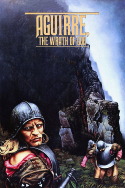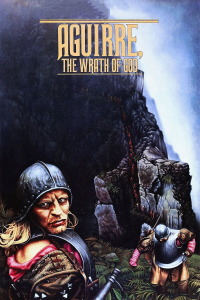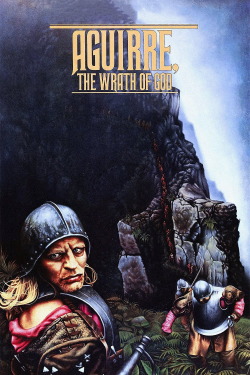
Review of Aguirre, the Wrath of God (1972) by Stephen R — 31 Mar 2010
An Alphabetical Guide to Every Film You Ever Need to See Vol.3.
"That man is a head taller than me. That may change".
These people do not belong here. This is the thought that runs through one's head during the opening moments of Werner Herzog's 1972 masterpiece Aguirre: The Wrath of God. The film opens with a seemingly never ending line of 16th century conquistadors descending some South American peak. Many of them wear armor, the women are dressed in long flowing gowns, slaves drag cannons and do there best to keep the livestock moving. Women are carried in large sedan cars that teeter vicariously when ever the land is a bit unstable. In these opening shots lies the essence of the film. These people do not belong here.
Aguirre: The Wrath of God is an adventure story that rolled around in the genius mud of Werener Herzog's brain and came out the other side as some kind of bizarro political allegory. The film gives a highly fictionalized account of a trek led by legendary conquistador Pizarro as he and his men search for the lost Inca city of El Dorado. When the terrain gets too rough Pizarro sends out a group of his men to scout the land and report back to him with their findings. Among these men is the deranged, violent Don Aguirre (Klaus Kinski).
Among men who are merely trying to stay alive a murderous man can get nearly anything he wants, and that's exactly what Aguirre does as in the span of a day he has taken over the group and has murdered or maimed those who might stand in his way.
Very few people have ever had as striking facial features as Klaus Kinski. He has the cheeks of a prisoner, the jaw of a movie star, and the eyes of a mental patient. His character is defined as much by his face as by the things he says, even without his insane proclamations ("I, the wrath of God, will marry my own daughter and with her I'll found the purest dynasty the Earth has ever seen") we know just by looking at him that this man is demented. What makes his character even more frightening is that Kinski is able to display such power without uttering a word. It is obvious from the beginning that no man is going to be able to stop Don Aguirre.
As the men move farther down the Amazon River the film's tone becomes more and more surreal. We see a large wooden ship stuck in the top of a tree, we see a man who has been beheaded finish his sentence. It becomes quite clear that as the characters in the story are getting further from the reality they know, Herzog is leading his audience further and further from the reality they know. The ever changing mood is remarkably effective, and Francis Ford Coppola would use a very similar technique in his film Apocalypse Now just 7 years later.
Aguirre: The Wrath of God is more than anything a study in the political consequences of natural selection. The men on this journey are slowly being picked off by natives who know the terrain, but Herzog only briefly shows these attackers. Instead what he shows are arrows coming seemingly out of nowhere, almost as if the jungle itself is on the offensive. This brings us back to the opening shots of the film, and the underlying theme of the whole film. These men do not belong here, and nature has a way of dispatching of those who attempt to take what is not theirs. It would be hard for me to believe that Herzog was not at least slightly influenced by America's participation in the Vietnam War, which would have been ongoing at the time of filming.
The filming of Aguirre is almost as legendary as the film itself. Herzog led his troupe of actors down the real Amazon and through very harsh conditions for the film. He also allegedly directed Kinski at gunpoint after he threatened to leave the film. All this adds up to remarkable authenticity in the kind of picture that is usually lacking in that department. The cinematography is stunning from beginning to end, and the final shot of Aguirre The Wrath of God gives us one of the great, iconic images of the cinema. It's the perfect ending to one of the best movies ever made.
This review of Aguirre, the Wrath of God (1972) was written by Stephen R on 31 Mar 2010.
Aguirre, the Wrath of God has generally received very positive reviews.
Was this review helpful?