Review of Agora (2009) by Byron B — 08 Aug 2010
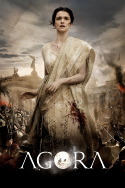
I had been anticipating this film for awhile. I knew the story already from a stage play that was influential to me in a number of ways. I thoroughly enjoyed seeing the life and legend of Hypatia of Alexandria portrayed in this epic way. This film is worth multiple viewings to me.
Alexandria was a cosmopolitan city near the end of the Roman empire. Agora is Greek for a public meeting place or market place. The word is mentioned once. It is a little mysterious why Agora was chosen for the title. I suspect it may have something to do with the symmetry of the word with the circular "O" in the middle. Also it loosely represents the place where the different religious factions: the pagans with a mix of Greek and Egyptian gods, the growing Christian movement, and the traditional Jewish population, begin to tear apart the fabric of Alexandria because of their differences. Whereas Hypatia's classroom where she teaches philosophy, mathematics, and astronomy (notice that is not astrology) is a place of brotherhood for all her students from various backgrounds. Hypatia was a Neo-Platonist, which means in part that she believed in ideal mathematical forms.
We begin in 391 CE. Hypatia (Weisz) has a position of influence as a teacher and lives a scholarly life with her father Theon (Lonsdale). Weisz is wonderful at portraying Hypatia as human and not some idealized martyr for Atheists. Theon is portrayed as not being friendly to the Christians among his household's slaves. And Hypatia's brotherhood ends with the position of slaves below citizens of her social level. Davus (Minghella) is Hypatia's slave. He pays attention to the lessons as much as the official students and shows he is intelligent. Hypatia builds him up for his mind one moment then seemingly without realizing insults him the next. Davus also has a forbidden physical attraction to his mistress. Minghella's character is hard to pin point. You don't know if you should root for him or be frightened. Among Hypatia's students are Synesius (Evans), a Christian, and Orestes (Isaac), a secular young man who is a defender of the Pagans and sees the authority of the Roman government. Orestes also publicly declares his love for his teacher. Evans doesn't get as much screen time to shine, but Isaac is stellar in his sympathetic role. The Pagans and the Christians keep seeking revenge on each other for insults to their deities. Davus meets Ammonius (Barhom), a Christian leader on the streets of Alexandria, and begins to see the power he could have as part of this relatively new group. Many die on both sides and the Pagans end up barricading themselves around Theon's house and the great library. The Pagans are allowed time to escape with their lives and Hypatia tries to save as much knowledge as possible in the form of library scrolls, because it is decreed that the Christians shall be allowed to ransack the library. A tragic historical event of great loss that Alejandro Amenabar shows us turned the world upside down.
The movie then jumps several years ahead. Text on the screen explains that many Pagans have converted to Christianity in order to keep their lives in the interim. Orestes is now the prefect or local representative for the Roman emperor. He has been baptized since the empire's official religion is Christianity. Synesius has become bishop of Cyrene. Both Orestes and Synesius keep in touch with Hypatia. Orestes sees her in person since he has stayed local in Alexandria and they share ideas. I find it interesting from a book I read by Maria Dzielska that the main historical documents that still survive that give us a look into this time and Hypatia's life are letters written by Synesius to various people including Hypatia. Hypatia has been continuing experiments to understand the relationship between the Sun and Earth and other wonders, or stars. She is always questioning! A priest named Cyril becomes the new bishop of Alexandria. Davus and Ammonius are now members of the Parabolani, who serve the bishop when some muscle is needed. Davus never turns his mind off and is very conflicted. The Christians led by Cyril turn their attention against the Jews next. When Orestes and the council won't do what Cyril wishes in regards to making the Jews leave the city, Cyril goes to the source and begins to make charges against Hypatia.
The movie reminded me of Carl Sagan's Pale Blue Dot as the camera often pulled away from the fighting in the ancient city of Alexandria, which must have seemed so BIG in human affairs of the time, to show us how SMALL we are on the global scale and in the grand expanse of space. Well, the grand expanse of space and Earth's real place in it are Hypatia's concern. Rather than relying on the unchanging word of law in the Bible, she encourages us to search for the truth.
This review of Agora (2009) was written by Byron B on 08 Aug 2010.
Agora has generally received positive reviews.
Was this review helpful?