Review of Agora (2009) by David E — 22 Oct 2010
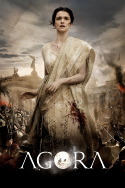
I can't believe I never heard of this movie until it popped up as a recommended title on a movie rental site I subscribe to. This is a beautifully-made period/ historical drama which is set in the 4th century A.D. in Alexandria. The central character in this story is Hypatia (played by Rachel Weisz) a renowned female scholar who taught philosophy, astronomy, and mathematics. Though Hypatia is beautiful and desirable to males (having many male admirers), she is quite oblivious to this effect she has on men, preferring to immerse herself in scholarly pursuits.
Some of her male admirers are Davus (Max Minghella), who happens to be her slave; there's the Christian student, Synesius (Rupert Evans); and finally, the openly admiring Orestes (Oscar Isaac) who declares his love for Hypatia during a public gathering - her reaction to this? By offering him a 'token' in the form of a rag smeared with her menstrual blood, a blatant and obvious message of rejection. There are more serious things explored in this drama than romantic pursuits. Alexandria is in the midst of a serious conflict between the pagan aristocracy to which Hypatia and her father belong, and the rising Christian militant movement called the Parabolani. The Jews are sort of caught in the middle, and the divisions between the upper and lower classes, as well as slaves, further exacerbates the situation.
Fast forward a couple of years, and the library at Alexandria is now a holding pen for animals - a man named Cyril is the Patriarch of Alexandria, i.e. the leader of the Church; Orestes has converted to Christianity and is the Imperial Prefect of Alexandria, he is also dependent on Hypatia for her advice and appears to have set aside her rejection of him in the past; Synesius has risen to the position of Bishop; and Davus has joined the Parabolani. Hypatia continues to teach, though in a much diminished capacity - she also continues to fervently study the planets and their movement. Little does she realize the very real threat posed to her by the increasingly militant Christians who perceive her as a threat both because of her paganism and the influence she wields over the Prefect Orestes who is frequently at odds with Cyril.
I'm not sure as to how much of this movie is period authentic, but I was impressed by the quality of the sets, and the direction. The acting was also above average - Rachel Weisz was incredible in her role as the strong-willed scholar who was way ahead of her time in terms of being a respected female scholar, and in the way she thought not only about astronomy but also about faith ( in one insightful dialogue between Hypatia and Synesius, she says, "You do not question your beliefs, but I must.").
Is this movie anti-Christian? I do not believe so - I think it portrays the events (based on whatever sources are still available) as they occurred during that period. Both the militant Christians, the black-robed Parabolani, and the Jews are depicted as being in conflict with each other -acts of stoning abound in this movie (must have been the favorite method of retaliation at the time?). More interestingly, I looked at this movie as depicting the conflict between religion and science, an age-old conflict that persists to this day. How much do we take on faith, and how much of science can truly explain all there is to be explained? Hypatia's theories about the movement of the planets was considered blasphemous, against Church teachings, yet time proved her theories had merit. I prefer to think of this movie as a thought-provoking drama that makes one ponder about the relationship between man, faith, and science.
This review of Agora (2009) was written by David E on 22 Oct 2010.
Agora has generally received positive reviews.
Was this review helpful?