Review of Agora (2009) by Uma K — 15 Aug 2012
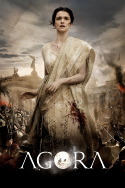
The film Agora explores, without sentiment or melodrama, a time period and a subject that I have often overlooked; the violent and tragic end of the Pagan Classical World and the beginning of the Christian Dominated West, which also launched the Dark Ages. Watching this film I cannot help but ask myself, would we have been better off if the worshippers of Serapes and Isis had won the day.
The movie was divided into two historic parts: the sheltered pagan world of wealth and status-quo where Christianity was no more than an annoying cult; and the Christian world under Emperor Theodosius with all of its early Patriarchs and Saints. The filmâ(TM)s main character, Hypatia, was a sheltered, brilliant, upper class Pagan: a mathematician and philosopher living in a liberal world of free thought. Before her, all the ancient knowledge of Rome, Greece, and the Near East lay in scrolls in the Great Library of Alexandria: a treasure that only the pagans seemed to comprehend. This pagan world felt a little bit like our own, with its freedom of thought and its blind belief in the universal search for knowledge and understanding. One of my favorite things about the pagan world was that the elite Patricians and the wealthy Jews all enjoyed the theater.
The pagan world presented in the film had a dark side as well. The slaves although treated somewhat warmly still had to wear a collar and they were also whipped. Another problem was in the established pagan cult religion of Serapes and its high priest who was an ass. But arenâ(TM)t so many âhigh priestsâ? and people in authority asses, even today. It was a world in decline but Hypatia and the other privileged Pagans didnâ(TM)t know it. She dwelt in the realm of the mind, protected by the Serapium and walls of the Great Library. Yet down below in the Agora the growing number of discontented Christians were about to rise up and smash the pagan world to bits. And thatâ(TM)s exactly what they did, by tearing down the statues, taking over the city, and burning all of the scrolls in the library to ash, thus casting a darkness over the mind of the world which wouldnâ(TM)t lift until the Renaissance.
In the second half of the film we see Christianized Alexandria some years later. Here the freedom of the mind that was so prevalent in the beginning has been crushed. Most members of the pagan Patrician class have by now converted to Christianity whether they believed in Christ or not. Hypatia is the last holdout, huddled in her mansion working on her brilliant theory of a heliocentric universe while the world around her slips into intolerant religious darkness based on faith and scripture alone. As the Bishop held the Bible over his head proclaiming that the scriptures say that women should be seen but not heard a chill went down my spine. The Christians had traded in all books and all knowledge for that one book: the Holy Bible. And we today are still suffering under the yoke of that mindset whenever evolution is disputed or someone thumps their Bible proclaiming it to be the indefatigable word of God.
This review of Agora (2009) was written by Uma K on 15 Aug 2012.
Agora has generally received positive reviews.
Was this review helpful?