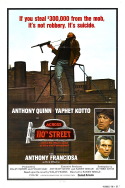
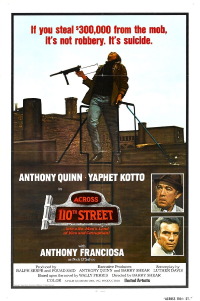
Review of Across 110th Street (1972) by Samy A — 09 Jun 2014
I was only familiar with Across 110th Street because the titular theme song was made popular by the release of Quentin Tarantino's Jackie Brown. And I felt a need to look back at the films that influenced him to make it, so when I heard that Across 110th Street was a critically acclaimed film that surpassed the standard of blaxsploitation films, I knew it had to be seen.
Across 110th Street transcends the limitations of the blaxploitation genre because even though it follows the traditional style of filmmaking usually implemented into a film of the genre, it is actually a legitimate crime drama that aspires to be something more. Across 110th Street has it's faults, but it actually tries to be better than the same basic blaxploitation film that everybody has already seen in films like Shaft. It adopts the visual style and groovy mood of the standard blaxploitation film and adds them to a film with gritty subject matter and serious intentions so that it grows to be a lot more than people may have once expected from it.
Director Barry Shear actually takes the opportunity really seriously in Across 110th Street, because the way that he integrates both a strong African-American figure like Lt. Pope into the story and teams him up with a semi-racist but streetwise figure like Capt. Mattelli so that the nature of Across 110th Street is versatile and deals with both African-American issues and the involvement of an Italian-American figure in the matters. Across 110th Street is more versatile than the standard blaxploitation film, and though it is not the most consistently interesting film it certainly has its virtues.
As with many blaxploitation films, Across 110th Street has a premise which is fairly formulaic of a crime drama and lacking of all that many surprises along the way. And the handling that director Barry Shear gives the film does not mean that it can transcend the nature of its story or the slow pace. So the script is imperfect, and despite the fact that it has a lot of sufficient dialogue for the actors to work with a plenty of sophistication the story just is not consistently interesting. That kind of has to be expected from crime dramas of the 1970's as many of them were routine and similar, and the fact that Across 110th Street manages to add more to that than the standard film is beneficial but there is still a lot of formulaic elements to it in terms of basic storytelling which a director like Barry Shear is not ready to break free from the limits of.
The fact is that Across 110th Street is a dated film and is not one of the more defining films of the blaxploitation era because it actually makes an effort to be something else, but the style of the film is just terrific. I mean, the cinematography has the same rough-edged gritty style of the standard blaxploitation film as well as being edited at a nice pace. And the action scenes are especially entertaining thanks to the visual style of the film capitalising on them and adding a touch of blood and gore in the right places. And it is all executed against the backdrop of some great scenery which is grey to symbolise the monotonous nature of the crime in the film.
The musical score of Across 110th Street is very energetic as well, and the titular theme song is just so damn groovy, so most of the best aspects of Across 110th Street lie in its technical characteristics and the fact that looking back at them by today's standards reveals a sense of nostalgia.
And thanks to the skilfully crafted dialogue in Across 110th Street, it ends up as a rounding success.
Yaphet Kotto makes a fine lead in. Due to the gritty nature of his line delivery, he supplies a natural sense of rough-edged sophistication. His stature is confident and so he supplies a viable leading man for the story because he deals with all of the material on a very professional level without resorting to stereotypical character elements. He constantly maintains a level of power in Across 110th Street since he has a lot of dedicated strength to the script, and so he leads the story well in a character that defies the stereotypical elements of most African-American blaxploitation heroes. Yaphet Kotto gives it his all in Across 110th Street and it empowers the drama of the film.
Anthony Quinn gives the most memorable performance of the film though. The two time Academy Award winner makes a powerful team with Yaphet Kotto because he is able to create a strong chemistry between the two which is tense due to the different backgrounds of the characters and the nature of the situations they approach, but Anthony Quinn comes out on top with the best performance of the film. He has a sense of humanity in the role, and along with it he also has a certain kind of fearlessness. Anthony Quinn steps up to the role of Capt. Mattelli with every intention of dominating the screen and that is precisely is what he is able to do since his execution is spot on in achieving the mood of the film. Executing a tense ability to interact with all the other characters in the film while also holding his own as a tough and gritty cop, Anthony Quinn finds the right kind of balance between themes in his performance which results in a fine leading effort. It is no surprise that Anthony Quinn's performance in Across 110th Street is powerful, and it is one of the finest aspects of the film.
So Across 110th Street has the flaws of a story which isn't the most consistently interesting and it is limited to being within the normal formula of a crime film from the 1970's, but the genuine fact that it combines elements of both crime drama and blaxploitation so well with powerful acting and true grit makes it worth the viewing.
This review of Across 110th Street (1972) was written by Samy A on 09 Jun 2014.
Across 110th Street has generally received positive reviews.
Was this review helpful?