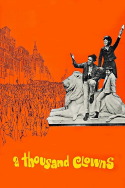
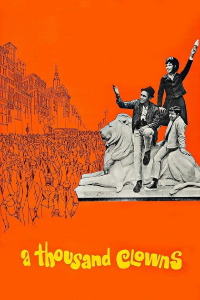
Review of A Thousand Clowns (1965) by Tomas H — 20 Feb 2010
This film is nearly perfect. New York City, 1965, is a playground in transition, just like the main character himself, Murray Burns (played perfectly by Jason Robards). Adapted from the play of the same title, the writer, Herb Gardner pumps this full of memorable dialogue - a rare delight when practically every line of the film is quotable (rarely seen aside from Ghostbusters IMHO). Fred Coe's direction completes the NY context to such emotionally sophisticated characters, emphasizing their identities and actions with what is arguably the MOST central character - The City, 1965.
My only slight beef with such a remarkable film is along dated issues with the blatant sexism surrounding Barbara Harris - who in fairness is wonderful in a richly dynamic and genuine. But Murray quickly sums up all of her emotional issues as a woman attempting to save the world as a PhD career girl, when really she's just emotionally spreading herself thin and needs to settle down to just mother just one family, rather than tackle the social welfare of a giant city full of lost children. While this arguably works with the similarly questionable sanity she has with Murray and even Nick, it is an odd and throw-away message leftover from 1965, in what "Madmen" on AMC today focuses quite closely on - male dominace, male problems, the labors of male control, boo hoo for all the poor successful grown boys on 60s Manhattan.
The problem is NOT that Barbara Harris' portrayal of Sandra is not cut out to be a career girl in the field of child welfare services - the problem is how quickly Murray is able to sum up her "female emotional traumas" and her **immediate** acceptance of his evaluation that mommies-belong-at-home.
But all of this works PERFECTLY to accompany Jason Robards character. It makes complete sense for his Peter Pan syndrome to ultimately be seeking an omnipotent mother in his house full of eagles and the freedom they radiate (even if she does replace them with new curtains). What doesn't sit right is the social value in the contrast between Sandra's growth, and Murray's. Again, they are perfect characters, but Murray is self sufficient, and Sandra is simply bouncing between men and their "stability" - "stability" to me seemingly looking like a euphamism for money evoking a terribly bitter opportunistic view of women. It subconsciously makes her and all women (as there is a distinct lack of them in this film) look like the chaperones to end this giant male party called, New York. Her struggle: pick a stable man. His struggle: make ONE OBVIOUS CHOICE to make the right decision - which is fortunate for us that he doesn't make as easily and quickly as Sandra, because such an amazing film would only be about a half hour long.
Regardless of my feminist rhetoric - see it. Total must see, and all of my arguments are easily arguable. That is the beauty of such rich characters expertly translated to the screen from the stage and so perfectly portrayed by the cast. And if nothing else, you too will be mesmerized at the beauty of New York, 1965 through the eyes of Murray N. Burns.
This review of A Thousand Clowns (1965) was written by Tomas H on 20 Feb 2010.
A Thousand Clowns has generally received very positive reviews.
Was this review helpful?