Review of A Stranger Among Us (1992) by Paul Z — 06 Sep 2011
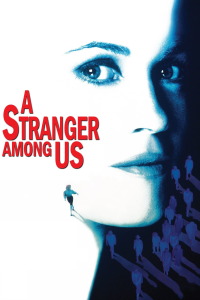
Thematically, A Stranger Among Us is definitely a Sidney Lumet film, sharing with much stronger installments in his repertoire the importance of the morally and emotionally committed life, the necessity for the individual to accept personal responsibility, and the archetypal human struggle toward self-definition and human potentiation in a complex universe. Melanie Griffith builds a strong characterization as an unsentimental homicide detective, who goes undercover to probe the murder of a Hasidic diamond cutter. To do so, she lives with the family of an elderly Holocaust survivor who is revered in his highly insulated community for his prudence and care for his fellow Jews. He tells her, "You and I have something in common: We are both intimately familiar with evil. It does something to your soul." And after the very brief, not overly graphic latter sequence, Griffith shows both grit and mercy to a dying thug played by a fine actor in a debut role, who cries, "I'm so scared." Lumet's camera looks sharply down at him as she lets him hold her hand as he dies.
But in terms of content and technique, there are deep-rooted snags completely uncharacteristic of Lumet's gamut. Griffith is attracted to Thal, the good-looking young rabbinical student bound to be the next community chief, who long-sufferingly clarifies that a marriage has been prearranged for him and that he must defy the appeals of the flesh, namely hers. Because he does so effectively, and because we agree he should, there's no dramatic tension here, merely very forced dialogue. Then there's the crime. I won't spoil the particulars, trifling and substandard though they are, however given the barefaced blood stains on the ceiling, what's astonishing is that every other cop didn't notice the body before Griffith did. And when she immediately deduces the identity of the culprit, the evidence she applies has been on hand the whole time. But Robert Avrech's screenplay has her exclaim her interpretation in one false, obvious Poirot-wannabe oration.
So, if the separate workings of Lumet's portrait of culture shock in half-baked romantic thriller masquerade were deconstructed, considered independently, they may not arouse much belief in the material's promise. No help is found in a title that shrieks A&E made-for-TV movie. One could sensibly have estimated to confront a film with less profundity, and certainly no theoretical significance. Rather, Avrech brews his script in some surprisingly perceptive moments. It develops as an involving and reverent handling of a frequently tainted creed. The film finely informs us about not just highly elaborate rituals and mores, but also theology, annals and folklore.
How does it attain such a degree of achievement given the fairly revolting elements? Maybe this craggy cobble in Lumet's rocky road through the 1990s is much like Judaism itself. The grandeur of an orthodox Jew's general experience bewilderingly manages to overshadow the whole of its pieces. I distrust that the NYPD normally dispatches officers to room with potential suspects, yet she goes undercover living with the Rebbe's family. The movie is clearly recycling the Witness/Beverly Hills Cop fish-out-of-water convention, but Lumet and Avrech's steadiest level of operation is not in telling a whodunit mystery which basically hibernates for a good portion of the film just to resurface at the climax seemingly to recap us on an overlooked job half-done.
While there are a couple of imaginatively worked and remarkable enough moments of action, one introducing Griffiths' character with expert terseness, and one much later, such sequential touches blanch in contrast to the enigma of a people's dedication to a god, the enigma which this minor Lumet effort attempts to explore. An important element of Griffith here is that she's unrepentantly sexual. Not cheap or slutty, just comfortable with hetero dynamics. Thal's her counterpoint. Their aforementioned rapport is definitely not "bashert," but all together, the empty spaces in either character can be fulfilled by something inside the other. There have been countless films showing or trying to show sincere, genuine devout Judaism. The Jewish screenwriter and the Jewish director have collaborated to give us something both flaccidly formulaic in its genre execution, but rewarding to contemplate in regards to their common heritage.
This review of A Stranger Among Us (1992) was written by Paul Z on 06 Sep 2011.
A Stranger Among Us has generally received mixed reviews.
Was this review helpful?