Review of A Night at the Opera (1935) by Edith N — 14 May 2010
There Ain't No Sanity Clause.
KCTS still plays movies most Fridays at ten. Not every Friday; in fact, there will be long desert stretches of [i]Nature[/i] or the dread "Members' Choice." And often, they will be movies I've seen and don't like or didn't see on purpose. Sometimes, alas, they will be movies which I desperately want to see but which Graham has no interest in. However, when I was doing my standard glance-through of this week's schedule, I discovered it was a movie we would both love. There is no greater joy than expecting a barely disguised infomercial for some guy's brain power thing and instead getting acolytes at the high altar of comedy. Like John Lloyd Sullivan, we can delight in the fact that we, too, are laughing--and while it's more common than it feels sometimes, the Marx Brothers are something Graham and I can enjoy together. We were both laughing, sharing the sheer joy and delight. It's a good feeling.
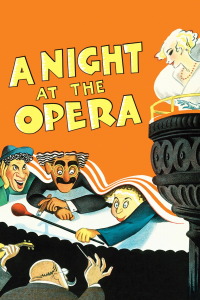
While it is generally true that the plot on a Marx Brothers movie is only tangentially important, it does feel polite to sum up anyway. Of course, there is Otis B. Driftwood (Groucho Marx), who is blatantly fortune-seeking in his attention to Mrs. Claypool (the redoubtable Margaret Dumont). He gets her to donate a lot of money to the New York Opera Company, but as she does, she is wooed by its director, Gottlieb (Sig Ruman), who sees Mrs. Claypool as his own gravy train and wants Driftwood to give her up. Meanwhile, there is Great Tenor Lassparri (Walter Woolf King), who charges a thousand dollars a night and fires World's Most Incompetent Dresser Tomasso (Harpo). There is also Up and Coming Tenor Ricardo (Allan Jones), who loves Great Soprano Rosa (Kitty Carlisle) and has as a manager Fiorello (Chico). Obviously, the goal is to bring down the arrogant Gottlieb and Lassparri, get money for the trio, and bring together Ricardo and Rosa, not to mention furthering their careers.
But really, as with any Marx Brothers film, that's really just something to point them at. It's a way to string bits together. There is, of course, the classic bit in Groucho's tiny, tiny room on the ship--booked for him by Gottlieb, naturally--wherein he ends up crowded out of his own room. There is the hilarity at the end, where things become less and less probable yet still completely possible in the reality the trio inhabit. (This is their sixth movie, their first without Zeppo. Technically, there was one before that, but it was screened only once and Groucho didn't like it.) Half the fun is watching the Brothers, in their world, slip into that inhabited by other people. It was Margaret Dumont's role in every movie she did with them. Groucho actually flat-out said that the reason the story worked was that she didn't know what he was talking about, and largely, this is true of the entire rest of the cast. Could Ricardo get away with the what he does on his own, without the Brothers? He could not.
The bane of any Marx Brothers movie is the musical numbers. We must always pause to let Harpo, well, play the harp, but the opera singers, well, sing too much. The problem executives seemed to make with these movies is to assume that anyone really much cares about the romance. The romance is stuck in to explain why everything else happens inasmuch as there is a why. Yes, all right, we also kind of need it to give us a title, but we all know the new guy is basically a replacement Zeppo. The straight man. Everyone in a Marx Brothers movie has a job to do, and all of those jobs are backup to the real point. No one has ever said to themselves, "Hey, let's watch a Margaret Dumont movie!" What we need from her is to be pompous and not understand Groucho's jokes. What we need from various of the other characters is a comic foil, a straight man, or an ingénue. The reviled director of this one, Sam Wood, seems to have missed that point.
The great joy of the Marx Brothers is the three types of comedy. Harpo is mostly physical, because of the not talking. (For all that, he's very expressive.) Chico is the wacky. He thinks he's smarter than he is, and all of his failings stem from that. Groucho is the clever, snarky one. His comebacks and put-downs are the stuff of legend, on film and in life. When the three come together, it is pure joy in its simplest sense. There is a great love of life and performing and just comedy in these movies. What's more, they only bring down those who deserve it. When Lassparri fires Harpo, when Gottlieb steps on Groucho's toes, the quote of a fine grey rabbit comes to mind. Groucho (the character name basically never matters) is perfectly willing to go on with his quiet life of sponging off Margaret Dumont, but when crossed, he'll get his own back. They are also devoted to one another. When Harpo is mistreated, Chico steps right in. They are equally devoted to anyone they've taken on for protection. The Marx Brothers are warm, funny, and intelligent. Modern comedy should be that way, too.
This review of A Night at the Opera (1935) was written by Edith N on 14 May 2010.
A Night at the Opera has generally received very positive reviews.
Was this review helpful?