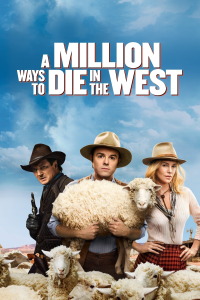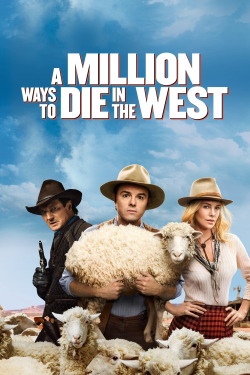
Review of A Million Ways to Die in the West (2014) by Bridgetwalters — 16 Aug 2019
Westerns are an essential icon to the Hollywood film industry. What came along with this was an overwhelmingly “toxic masculinity”. There was also a steady stream of racism, inaccurate portrayal of cultures, and popular gender roles were strictly abided by. This was the first Western in history to achieve the comedic goal of entertainment while breaking every commonly held cliche stereotype, and giving an accurate and often crude realization about the horrible place the West really would have been. The opening sequence shows a hanging party, wagon train, a patient suffering from a flesh eating disease, and finally a picture of Miss Myrtle Meriwether who was the real life Miss America in 1880. In just the opening sequence it has polarized everything we have seen of the West; both its beauty and its danger, but in a way that is totally unique to Hollywood films of the past. Albert Stark is nothing like a “cowboy”. He’s the guy who would probably die first. In fact, much of the movie is only possible because the audience expects to employ a sense of suspension of disbelief in order to watch anything Seth MacFarlane writes. This plays to his advantage in my opinion because no one expected him to do anything with this film except entertain. It’s in the middle of this entertainment that one eventually sees how a different kind of cowboy might have been born on the screen with writing of this type. Guys like Albert existed in far greater numbers than John Wayne or Clint Eastwood, but with the movies to glorify men beating each other up, killing Indians, and taking women as they pleased, who would want to be Albert? Our culture and knowledge has changed so much over the years, and where early writers sought to gradize a terrible place in time, MacFarlane dares to challenge that narrative and present both the romantic abilities of the time and the under-acknowledged sad realities. One scene in particular throws all of these aspects into the forefront. In this maybe 3 minute dialogue he explains everything that is absurd about the west from social aggression to hazards of common labor options to simply walking to an outhouse. What most people go to a Seth MacFarlane movie to see is the jokes. They expect to be entertained and to laugh, and the film provides this throughout with plenty of crude and sarcastic humor alike. However, unlike some other comedic films, there is also a rich opportunity to learn little gems of truth about the times. There is another scene in which Albert and his new found friend Anna, played by Charlize Theron, go to the county fair. The recurring dialogue is “people die at the fair”, and although it is done in a humorous way, each example is both true of the old west, and sadly still true in America today. The major difference sometimes come down only to hygiene and the cultural change of smiling in every picture (which is also a running joke throughout the film).
The last major difference between the Hollywood Western and a Seth MacFarlane Western is the gender and racial normative roles of the characters. They still adhere to a realistic framework of the time, but in many places they highlight the diversity we see now as having probably existed, although on a smaller scale, during that time as well. Anna, the eventual love interest in the film is more of a “cowboy” than Albert. She rides with the most notorious criminal in the West, Clinch Leatherwood, played by Liam Neeson, and shoots better than anyone in town. Ruth, played by Sarah Silverman, is a prostitute in the local saloon, but “after work” has a loving and understanding relationship while also sticking to her Christian values. Cochise, played by Wes Studi, is the Indian chief who captures Albert but gives him the opportunity to speak, and once realizing he isn’t like the other settlers, brings Albert into the tribe and teaches him how to defeat his enemy, highlighting the obvious knowledge that Indian tribes indeed possessed at the time. Then, the last scene of the movie brings a cameo by Jamie Fox creating a parallel to the popular Tarantino movie Django. Fox walks up to one of the games at the fair called “Runaway Slave” in which participants are encouraged to target shoot cartoon depictions of slaves eating watermelon, and subsequently shoots the vendor and restating the line, “People die at the fair”. Earlier in the film Albert states that it seems a little racist, asking why it couldn’t be ducks or rabbits. The culture of the time thought it was perfectly normal sometimes mirroring the way throughout history blatantly racist themes have been widely accepted. This small scene also highlights the often unacknowledged reality that America, even though post Emancipation Proclaimation, were still a nation based widely on slavery and discrimination. I feel like this film was under appreciated at its release, but will be a benchmark for social accuracy in the future.
This review of A Million Ways to Die in the West (2014) was written by Bridgetwalters on 16 Aug 2019.
A Million Ways to Die in the West has generally received mixed reviews.
Was this review helpful?