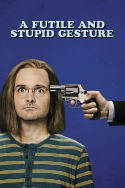
Review of A Futile and Stupid Gesture (2018) by Sean G — 28 Jan 2018
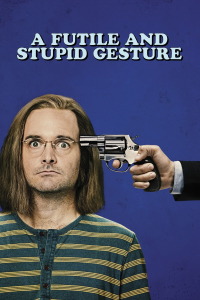
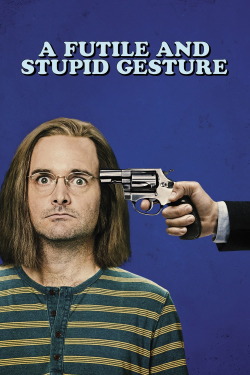
This biopic about the brilliant comedy writer Doug Kenney and the origins of the National Lampoon, through his meteoric rise as a Hollywood scriptwriter, right to his tragic accident?/suicide? has been anticipated for months - by me, anyway. I am a huge fan of Kenney's and have read most of his output, as well as the source biography of the same name by Josh Karp.
The movie premiered yesterday on Netflix. I found it only meh. I wanted more from it, although I can't really think what could be done better. Doug Kenney is an elusive character. The only real look at him I've ever had is in the movie Between the Lines - in the movie's final scene, he plays a bland nobody talking to a rock critic (played by Jeff Goldblum), and you can hear them talking over the closing credits. That and his one line in Animal House ("What the hell are we supposed to do, ya MO-ron!?") are just about all we have to go on. In Between the Lines, he doesn't exactly spring out of the celluloid with his energy. As I'm writing this, I'm listening to a recording on You Tube of Kenney talking to a group of students at UCLA in 1972, and he was not a scintillating speaker. Kenney was a writer of jokes - and one of the greatest ever - but not a deliverer of them.
(By the way, if you want to see that scene in Between the Lines, the entire movie is on You Tube - go to the 1:33:00 mark of the movie. Or do yourself a real favor and watch the entire movie. It's a lost treasure.).
So Will Forte, who can't make an utterance without throwing off 50 different colors, was supposed to play the gray wallpaper that was Doug Kenney. I doubt he really captured Kenney, and probably shouldn't have.
The movie focuses on his misfit status as a child, his discovery of his comic ingenuity at Harvard and his desire to keep the comedy rolling with his writing partner Henry Beard with the founding of the National Lampoon. He wrote comedy of staggering ingenuity and subversion, often in the soul-deadening pastels of Americana, culminating in the "1964 High School Yearbook Parody," which I say without any exaggeration is one of the funniest things ever written. He went on to co-write the scripts for Animal House and Caddyshack, the most successful comedies of all time up to that point.
Trouble is, if you didn't know how brilliant Kenney's comedy was already, you didn't get any sense of his genius from the movie. The writers of this movie and the director, David Wain, made no attempt to portray any of Kenney's material. So if you didn't know his material already, you just have to take their word for it. All you get are the smart-ass one-liners written into the script, which, we presume, some came from Kenney and some from the writers of the script to serve the storyline.
But there is a story to tell here. Kenney is a man on whom wealth and success was dropped as if from a dump truck. Unable to impress his father with his success and unable to stay faithful to the women to whom he committed himself, able to write brilliant comedy, but unable to discipline himself like an adult, ridiculously successful, but becoming disenchanted with Hollywood interference (he hated the gopher subplot in "Caddyshack"), the movie takes him at the moment of his professional peak and his personal depth of despondency to the Edenic mountaintop in Hawaii, from where he fell to his death.
People who knew him have varying opinions as to whether it was an accident or suicide. Harold Ramis famously said that he probably fell looking for a place to jump. The movie doesn't take a stand - and again, it shouldn't.
The major figures of Kenney's life are portrayed here by contemporary actors. Some of these characters are quite famous, and it can be a fool's errand to portray people who have such an indelible image on the public's mind. Jon Daly, a tremendous comic actor, has a very good Bill Murray impression, and takes center stage in a fantasy sequence in Murray's lounge singer character, Nick. It's hard not to notice, however, that Daly is a head shorter than Murray. The same is true of Tom Lennon's portrayal of the dark eminence of Michael O'Donaghue. He got his voice and his nihilism perfectly. If only he had an extra six inches of height.
However, I was shocked how good Joel McHale's Chevy Chase portrayal was. Of course, McHale and Chase worked together for several years on Community, where Chase was notoriously difficult to work with. I don't know if McHale and Chase are on good terms, or if McHale's impression was a healthy form of revenge for him. But the performance was first rate. And he had the height.
Anyone wanting to know more about this vital era in American humor should definitely read Josh Karp's biography, as well as Dennis Perrin's "Mr. Mike: The Life and Work of Michael O'Donaghue" and Tony Hendra's "Going Too Far." Not to mention every National Lampoon reprint you can get your hands on (ESPECIALLY the 1964 High School Yearbook Parody), at least for their material up to around 1979 (it goes downhill fast after that).
The movie ends with a funeral service with all the principals coming to pay their condolences, and the ghost of Kenney urging the dour mourners into a food fight (a la Animal House). I think this likely satisfied the authors of the movie far more than it would have satisfied Kenney, whose comedy was infused with far more ingenuity and satiric edge than this cheap gag. If you recall, the actual food fight in Animal House probably lasts for about two seconds, at best. That is not really the gag on which that movie's reputation rests, and does not typify Kenney's humor.
A far better ending would have been the way the movie's source biography ended. A few years after Kenney's death, Chevy Chase, who was very close with Kenney in his Hollywood years, was dragged to a séance by his wife. The host at the séance asked the guests if anyone had a question for any of their loved ones on the other side. Chase, putting aside his cynicism of the entire affair for a moment, said, "Yes, I would like to ask about my friend Doug.".
Without any other questions about who "Doug" was, the medium went into her concentration mode, and lifted her head, saying that Doug was very embarrassed, he had lost his glasses and slipped and fell off the cliff. As Chase stared slack-jawed at this response, the medium paused and said, "He was very funny, wasn't he?".
If you ask me, THAT'S the ending this movie should have. I can move forward in life with a spring in my step knowing that my friends and I get to be funny in the afterlife.
This review of A Futile and Stupid Gesture (2018) was written by Sean G on 28 Jan 2018.
A Futile and Stupid Gesture has generally received positive reviews.
Was this review helpful?