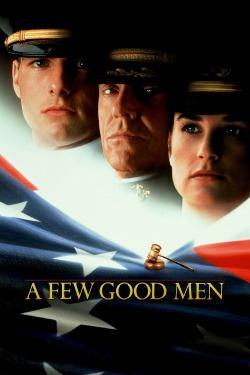
Review of A Few Good Men (1992) by Daniel C — 27 Nov 2012
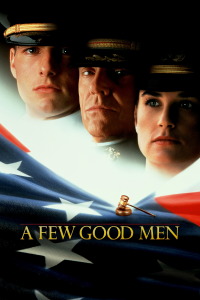
Yes indeed, y'all, we're talking about "A Few Good Men"... and Demi Moore. Shoot, as terrible as her bob cut in "Ghost" was, she may as well have been a man, which isn't to say that her haircut is that much better in this film and, well, quite a few other films. Shoot, no wonder Bruce Willis is bald now, his time with Demi Moore must have made him lose his faith in hair, yet that didn't stop Ashton Kutcher from falling for the botoxed "beauty", or at least until the affair, and that's the truth Demi, whether you can handle it or not. Man, real quick, that really is a great line from this film, but hey, I would expect nothing less from an Aaron Sorkin-written line delivered by Jack Nicholson, who could read "The Scarlet Letter" and make it exciting, or at least more exciting than the version featuring Demi Moore, which is good, because we're talking about a courtroom drama here, and in a case like that, you're going to bring in all of your guns if you're gonna liven things up. No, I'm kidding, this film is mighty entertaining, though that might simply be because it features Jack Bower from "24", Val McKee from "Tremors", G.I. Jane from, well, "G.I. Jane", Ethan Hunt from the "Mission: Impossible" film series and, of course, Jack Nicholson, who's so cool that you'd be splitting hairs if you were to pick out a particularly exciting character of his, so maybe that's why this film is so good. Well, that, and because the film is just plain pretty darn well-crafted. Still, while there are more than "a few good" spots all but throughout this film to very much get it by, the final product is hardly not guilty of making its share of shortcomings.
When dealing with a film of this type, where consequence and momentum is high yet all behind dialogue rather than action, pacing needs to seriously be taken into consideration, and while director Rob Reiner manages to pump enough juice into the atmosphere to produce entertainment value that compensates for potential slow spells, actual pacing is all but absent, leaving the film to tread along, slave to its runtime, and oh, what a problematic slave owner it is. Clocking in at 138 minutes, this film isn't exactly "JFK", yet it's certainly longer than it should be as a dramatic dialogue thriller, which would be more forgivable were it not for the film's all too rarely finding time for a break. Certainly, I'm not asking that this film has so much slow-down that it gets to be uneven and bland, and plus, there's certainly not so much intensity to the film's momentum that the excessiveness of exposition and plot progression gets to be exhausting, yet too much happens before you can find a full grip on dramatic resonance, which isn't to say that there's not dramatic resonance at all, as dramatic exposition can be found intertwined with the plot momentum. Still, even though it is, in fact, present, flesh-out exposition isn't given enough primary focus for you to feel its full effects, thus bite is diluted and the exhaustingness of the excessive happenings, backed by only so much full expository establishment, is called more to attention. While the film is all talk, there's too much action to the dialogue than flesh-out, and full investment suffers, and with it, actual plot dynamicity. It doesn't take too long before things get to be quite repetitious, with only so much dramatic slow-down and plenty of fat around the edges of action, or whatever you call dialogue that moves plot foward perhaps more than flesh-out, thus the final product comes out overlong and dramatically limited, and by extension, with only so much to remember. Of course, what is worth remembering is in most of the right place, which leaves the film to stand as both memorable and rewarding, for although there is perhaps too much going on for there to be only so much build-up, the film keeps you going through all of its moderate dramatic shortcomings, or at least Aaron Sorkin does.
Adapting his own play, Aaron Sorkin is certainly well aware of this material, and of how he can bring it to life, or at least liven it up, delivering dialogue that isn't exactly thoroughly snappy, yet consistently clever and lively, with moments in which it really flares and sparks particular color in these very dialogue-driven happenings, thus softening the blow of the plot momentum's excessiveness. What further secures the final product as quite a ways away from too exhaustingly overactive is, of course, the subject matter behind the overactive structuring, because although this worthy story's biting depth goes toned down by more plot than story establishment, the fact of the matter is that this subject matter is worthy, rich with, if nothing else, well-researched and highly intelligent legal intrigue that drives the action that drives this film, providing thoroughly fascinating layers and, by extension, engagement to the compelling case around which the story is built. There's a bit too much legal mumbo-jumbo and not quite enough human depth to fully compensate for this film's relatively and gratutiously sprawling runtime, yet Sorkin crafts an intelligently-concieved and eventfully-structured mystery thriller, case and overall conflict, and making it all the stronger with something that I have, throughout this review, justly been stressing is underused: dramatic depth, which should be much more prominent than it is, going diluted as it goes incorporated into the plot and conflict momentum that it should be fleshing out more than being tacked on to, yet still stands firm enough to establish quite a bit of dramatic depth that stands to colorize all of this conflict mumbo-jumbo, but still adds an adequate amount of human weight and consequence in order to keep you reasonably invested. Sorkin could have been more even in his pacing and flesh-out structure, yet on the whole, an undoubtedly compelling stage opus is generally well-translated as a compelling cinematic tale, brought to life by inspiration in the man in charge of truly bringing Sorkin's worthy vision to the screen: director Rob Reiner, whose pacelessness and emphasis on the missteps within Sorkin's script prove problematic, yet does not do too much to undercut what is done right in Reiner's direction, which juices atmosphere with livliness that supplements the intrigue of the legal aspects, keeps consistent entertainment value alive and well, and keeps what true depths that consistently rests within all of the near-exhaustingly underdeveloped happenings to go pronounced just enough to sustain your investment. The off-screen performances are flawed, yet strong enough to keep you going, and considering the caliber of the talents found within this colorful cast, you better believe that the on-screen performances help considerably in keeping you invested. Jack Nicholson is quite underused, yet, as you would expect, steals the show just about every time he steps into the scene as, well, himself yet again, and by extension, an effectively smooth figure, rich with as much mystery as charisma that commands the screen, while everyone else holds their own quite well, with James Marshall and Wolfgang Bodison compelling with believability and the occasional piece of emotional range as the honor-respecting yet fearful accused, Kevin Pollak and Demi Moore charming as our leads' worthy right hands, and leading man Tom Cruise engagingly thoroughly, through charisma and presence, as, well, himself, but also a justice-seeker who will find professional and human experience as he seeks out the truth. These performers and quite a few others grace the film with further color, and with the inspiration within the writing and direction being potent enough to cut through most missteps and establish a compelling core to all of the coloring, the final product comes out flawed, but ultimately worthwhile.
To close this case, the film's pacelessness and excessive length bring more to attention the limiting of expository slow-down to the overly eventful plot that would have benefited from more dramatic depth and tightness, yet still ultimately stands as pretty compelling, going complimented by Aaron Sorkin's clever dialogue and intelligently-crafted legal aspects, and brought to life by worthy subject matter and a still reasonable degree of dramatic depth, which are themselves brought to life by Rob Reiner's generally inspired direction, and complimented by the many colorful performances that help in making "A Few Good Men" a much more often than not compelling legal thriller.
3/5 - Good.
This review of A Few Good Men (1992) was written by Daniel C on 27 Nov 2012.
A Few Good Men has generally received very positive reviews.
Was this review helpful?