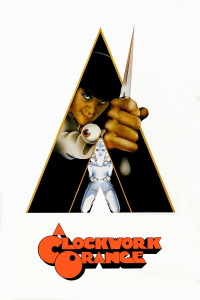
Review of A Clockwork Orange (1971) by Jacob D — 11 Nov 2016
Kubrick is my favorite director of all time. He has produced so many masterpieces, and so many of his films are seen as magnum opuses of their respective genres. It's also hard to pick his best film as I like most of his films more as I continue to re-watch them. I put off watching "A Clockwork Orange" for quite a long time. I knew about the violent/sexually explicit content in it. I wanted to make sure that I was desensitized before watching it. I didn't want to miss out on something spectacular due to it being too much for me to handle. When I did watch it, however, it only took 5 minutes for me to get engaged into the film.
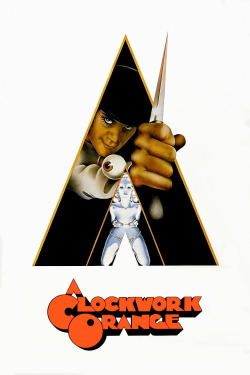
In future Britain, a violent gang leader named Alex DeLarge is betrayed by his gang, captured by the police, and put in prison. While there, he volunteers for an experimental aversion therapy created by the government in hopes of becoming non-violent so he can be released back into society.
Alex's parents seem to be completely clueless to the dystopian state of the world. Strangely, Alex has a fond love of classical music, especially Beethoven's 9th Symphony. Classical music is often played over scenes of violence, sex, and rape. In the opening scene at the milk bar, sexual imagery is present throughout it. This imagery is also found in many more scenes in the film. Those scenes display how most men are led around by their sexual desires, and contribute nothing to society. Liberal activists and therapists try to make Alex a productive member of society, and they try to get him to be non-violent. However, what's important to the film is that he doesn't change by the end.
Character arcs are meant to show how a particular character changes over the events of the movie. However, character arcs can also work even if the character winds up back at the beginning. The reason Alex DeLarge's character arc works so well is partly because of the fact that the viewer doesn't expect that it will happen. His resolution comes as a complete surprise. Another reason why it works is because it approaches character arcs in a different way. Its uniqueness helps it stand out from other films with memorable character arcs. It gives the viewer another reason to enjoy the film.
In the first third of the film, the viewer quickly grows to hate Alex. He seems to have no redeeming qualities to him. He beats and rapes numerous people throughout the film. However, in the final third, we feel sorry for Alex as he continuously gets beaten by people he hurt in the first third. The reason the viewer feels sympathy for him is because he has no free will. The government has effected him in a way which made him unable to defend himself. Despite everything we saw him do, we feel sorry for him since he is turned into a test monkey. The treatment quickly feels like torture. When the government tries to get him to mend their reputation to the public, it comes off like he's getting forced into doing it. The final scene has a somewhat positive effect on the viewer, as they know that the side effects the government caused Alex to experience will no longer effect him. This serves as the light at the end of the tunnel.
The visuals in the film are also pretty good. Kubrick makes full use of the wide angle lens. This is used on objects which are relatively close to the camera. Objects on the edges of shots tend to curve upwards. This allows us to view the world in a bizarre way, sort of like how Alex views it. These shots also allow us to get a clear view of the environment that the movie takes place in (this is sort of like the purpose of the long takes in "Children of Men"). Also, it's hard to forget the first shot of the film. The angle of the first shot makes Alex look menacing. The camera angle is positioned slightly above his head. This makes him look up at the viewer.
However, this only applies for camera techniques. The movie also has stunning cinematography. The settings look particularly intriguing. The phallic imagery gives the world a haunting feeling. The apartment block that Alex lives in looks rundown and poorly managed. It lets the viewer know that the environment has deteriorated overtime. There are a lot of scenes which look intricately designed. Although "2001: A Space Odyssey" is still Kubrick's most visually impressive film, this one doesn't fall too far behind it, and it remains as a strong contender for that position.
In conclusion, this movie is another one of Kubrick's many masterpieces. Behind all of the explicit scenes in it, it is a smart film. It explores the nature of free will and the relationship between man and the government. The character arc that Alex goes through is unique and enthralling. The movie also makes us become attached to Alex's character. On top of that, the film has outstanding visuals and camerawork. Finally, who can forget the iconic and haunting score which plays at the beginning? It sounds ominous, and it adds to the bizarre tone of the film. This is not an easy movie to watch as many people will find it hard to sit through. However, it's a must-see film. It just requires you to be desensitized to movie violence quite a bit.
This review of A Clockwork Orange (1971) was written by Jacob D on 11 Nov 2016.
A Clockwork Orange has generally received very positive reviews.
Was this review helpful?