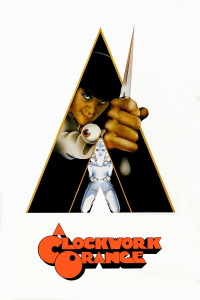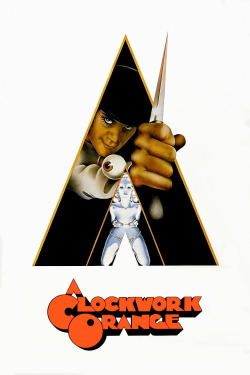
Review of A Clockwork Orange (1971) by Cinemassacre — 13 Mar 2016
Throughout his 50-year career, and especially in his great films, director Stanley Kubrick had a penchant for taking the novels of others and re-shaping them to fit his own vision. Of the 16 movies Kubrick directed (including his final feature, Eyes Wide Shut), the film maker was credited with script involvement in 12 of them. For that reason, 2001 is not referred to as "Arthur C. Clarke's 2001" but as "Stanley Kubrick's 2001." Dr. Strangelove is "Kubrick's Strangelove" not Peter George's. The motion picture version of The Shining owes a greater debt to the director than to author Stephen King. Similarly, the driving force behind A Clockwork Orange was more Kubrick than novelist Anthony Burgess.
One of the first things that will strike anyone watching A Clockwork Orange today is how thoroughly modern it looks. If not for the presence of the youthful face of established thespian Malcolm McDowell, one could be forgiven the assumption that the movie was made far more recently than 1971. Unlike many of its contemporaries, A Clockwork Orange is in no way dated, and the issues it addresses are as urgent today as they were three decades ago. How many other films from the early '70s can make this statement?
Part of the reason for the movie's contemporary look is Kubrick's forward-thinking philosophy of film making. From Lolita onwards, the director pushed the envelope. (In fact, one could argue that he did it before the 1962 film - overtly homosexual scenes from Spartacus were cut at the studio's insistence.) While human nature may not have changed since 1971, motion picture standards have. There is copious nudity, sex, and violence in A Clockwork Orange. And, while the sex is not pornographic and the violence is not explicit, they were pervasive enough to initially earn the movie an X rating. Today, the saltier elements of A Clockwork Orange fall into the mainstream of the MPAA's R category (and the film has since been re-classified as such).
A Clockwork Orange is not an easy motion picture to absorb or digest. Oddly, the sex and violence are easier to take than the razor-sharp edge of Kubrick's satire and the corresponding awareness of its pinpoint accuracy when addressing the issue of the dehumanization of people. As I write this in 1999, the extremities of A Clockwork Orange have not come to pass, but society is slowly moving down the slippery slope that the movie cautions against. I have the disturbing feeling that if the solution to crime proposed by the film (brainwashing) was medically and economically feasible, the government would leap onto the bandwagon. When one character speaks of our willingness to "sell liberty for a quieter life," it strikes an ominously familiar chord. Under its current mayor, New York City has yielded numerous freedoms in return for a reduction in the crime rate. And in Russia, the famished citizens would give up all their newly acquired rights for the promise of full bellies.
Many have watched A Clockwork Orange without understanding what it all means. And for those who take everything presented on screen in a straightforward manner, a certain amount of confusion will result. But, like Terry Gilliam's Brazil, George Orwell's 1984, and other futuristic political satires, A Clockwork Orange is meant to be understood as part allegory, part black comedy, and part drama. The film takes aim at the ineffective and inhumane methods often devised by governments to stem criminal behavior, asking what sacrifices we're willing to make to live in relative security. Then there's the trickier question of whether the removal of free will destroys an individual's essential humanity. Does the State have the right to do this, to "kill the criminal reflex"? Would execution be a preferable fate? Finally, Kubrick illustrates the fickle nature of public opinion. Those that laud the government's methods one day revile them the next.
A Clockwork Orange is not a pretty or comfortable experience. It does not pander to the crowd-pleasing mentality that shapes the structure of many films. (In that scenario, a Rambo-like Alex would have avenged himself upon all of his wrongdoers in the final fifteen minutes.) But it demands thought, compels the attention, and refuses to be dismissed. And, for that reason, A Clockwork Orange must be considered a landmark of modern cinema.
This review of A Clockwork Orange (1971) was written by Cinemassacre on 13 Mar 2016.
A Clockwork Orange has generally received very positive reviews.
Was this review helpful?