Review of 71 Fragments of a Chronology of Chance (1995) by Everett J — 26 Feb 2008
[i]71 Fragmente einer Chronologie des Zufalls.
[/i]dir. Michael Haneke.
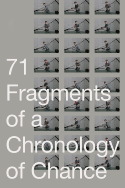
This wholly experimental film explores the nature of family, loss, and longing. It uses several loosely knit narratives to show different perspectives on these themes. Everything centers around an incident, taken from the papers, involving a man who walked into a bank and opened fire, killing three before shooting himself in the head out in his car. A bank employee who died is shown in one of the narratives just going about his daily routine. In another narrative a young Romanian boy named Marian Radu (Gabriel Cosmin Urdes) has entered Austria illegally and the film depicts his life on the streets digging food out of the trash, stealing comic books and later a camera. In an alien world he uses pictures to grasp hold of something solid and real. Later he is adopted by a family and the language barrier between them is exploited. here is also a story of an elderly man who's trying to convince his daughter to take better care of him.
This film is literally split up into 71 fragments and many of them are scant. There are several exceedingly long scenes; one scene shows a man playing ping pong against a machine for 8 minutes. Another involves the elderly man talking on the phone to his daughter. Finally, a shot of a dead bank employee with blood pooling from his head goes on for several minutes. Haneke deliberately employs these methods to drive his audience crazy with boredom, anger, and distrust. However, it is possible to move beyond these initial reactions to get into the rhythm of the sequence or to understand the poetry of these elongated scenes.
Overall, this film confounds and disrupts conventional strategies of narrative. It does so by challenging ideas that audiences have regarding the structure of films. Haneke deliberately forces his viewers into uncomfortable terrains where strong emotional reactions are necessary to grasp the material. In the end its a matter of showing daily life in all its pedestrian aspects in order to get at many possible truths of the human condition. There are many scenes where nothing important seems to be happening but this only cements the film in a stark, altogether familiar reality although it is done through the distorting lens of cinema. Haneke explores the nature of loss through the characters of Marian and the old man sitting in his chair attempting desperately to get through to his daughter. Also, the film employs television footage showing a number of atrocities and wars throughout the world to demonstrate the callousness and depravity inherent in all types of government structures. Strangely, it also uses footage of Michael Jackson's child sexual abuse allegations. Ultimately, this film is challenging and rewarding to those who enjoy being subject to quality filmic experiments involving disjointed narrative structures and ambiguity.
This review of 71 Fragments of a Chronology of Chance (1995) was written by Everett J on 26 Feb 2008.
71 Fragments of a Chronology of Chance has generally received positive reviews.
Was this review helpful?