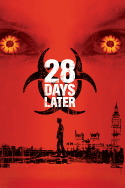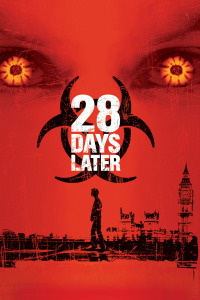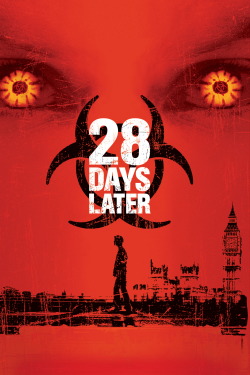
Review of 28 Days Later (2002) by Moviemaniac83 — 24 Apr 2015
The end of the world has always simultaneously fascinated and repulsed human beings. No less an authority than the Bible devotes entire books to the last days. And, since almost the beginning of science fiction, the apocalypse has been a popular subject. In fact, one of the most common science fiction subgenres (which gained popularity during the early Cold War era of the 1950s) is that of the post-apocalyptic survivor - an individual who lives through some kind of catastrophe (often a nuclear war) and must make his way through the hostile environment that exists in its wake.
Danny Boyle, the director of Shallow Grave and Trainspotting, has brought his off-center perspective to this story. Armed with a screenplay written by Alex Garland, Boyle's vision of humanity's twilight has mankind wiped out not by fire, brimstone, and nuclear fallout, but by disease. The living are divided into two categories: the infected, who are more like mindless zombies than human beings, and the survivalists, who eschew making plans, realizing that "staying alive is as good as it gets." The allegorical nature of the movie is impossible to miss. And Boyle touches upon such potentially weighty matters as the fundamental difference between man and beast, and whether human beings are natural killers.
The first half of 28 Days Later is a road movie, as Jim and his companions make their way from London to Manchester using deserted highways and facing nearly constant attacks from roving bands of the infected. The second half is a more straightforward action/adventure. The film contains one significant twist, and Boyle adeptly blends elements of horror and drama with the science fiction. In fact, one of the things that sets this movie apart from many similar cinematic endeavors is its focus on characters rather than action. The movie develops Jim, Selena, Frank, and Hannah into believable individuals. The situation is crafted in a way that seems almost plausible, and, once it establishes the rules, never cheats. The film's "villains" have credible reasons for acting as they do, and the ending doesn't feel cheap or false.
When Boyle wants to shock us, he has no trouble doing so. There's a little of George A. Romero (Night of the Living Dead) here. Several scenes in which the infected attack are genuinely creepy. One sequence in particular - in which Jim and Frank race to change a tire while a band of infected relentlessly approach - generates as much tension as any other 2003 motion picture. This is followed in short order by an effective character building sequence in which the protagonists enjoy a picnic while ruminating about what, if anything, the future might hold. Suddenly, Jim and Selena have become aware that the mantra of "just survive" is not enough.
I enjoyed 28 Days Later, although I would be the first to admit that it doesn't do much that's radical. It's better than most post-apocalypse stories because it cares as much about the characters and their circumstances as with developing battles and action sequences. Three of the primary actors - Cillian Murphy, Naomie Harris, and Megan Burns - are mostly unknown on this side of the Atlantic. The two recognizable faces - Brendan Gleeson and Christopher Eccleston - are character actors, not stars. Yet, perhaps because of the relative anonymity of the performers, the ensemble works.
28 Days Later is dark, the video quality is dubious (it was shot on digital video to curtail cost and provide a grittier look), and the subject matter is familiar. But the filmmakers counter these questionable qualities with solid performances, an intelligent script, and sure-handed direction. The result is a movie that kept me involved from start to finish.
This review of 28 Days Later (2002) was written by Moviemaniac83 on 24 Apr 2015.
28 Days Later has generally received very positive reviews.
Was this review helpful?