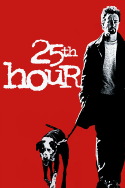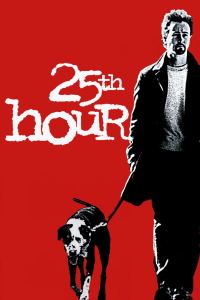
Review of 25th Hour (2002) by Cameron J — 03 Sep 2014
Woah, woah, woah, woah... woah, woah... woah... woah, woah, woah, woah, woah, woah... woah, hold on; white people have problems, too? Spike Lee made this film, and if he read that, it would still blow his mind... or lead to my mind being blown, but, yeah, the point is that where Edward Norton's character in this film is going to prison, Norton himself is continuing his probation to apologize to minorities for all of the slurring he did in "American History X". I'd give him props for trying so hard that he got Rosario Dawson, the most racially ambiguous gal in the movie business before Zoe Saldana, to be his movie girlfriend, but he kind of took a few steps back in this film with a beautifully over-the-top, if overlong scene in which he bad-mouths virtually every ethnicity, and, just for good measure, Jesus. I just love that he was ranting to himself in the mirror, because it just goes to show you that even in this kind of film, Norton had to go split-personality on us, and considering that this is kind of like an "American History X" rip-off in a lot of ways, it is the ultimate Ed Norton fan service. To be a Spike Lee "joint", this film actually isn't that much about race relations, but you can still tell, based on this film's style, that this is either Lee making up for not making "American History X", or, well, solid evidence that Tony Kaye wishes he was the white Spike Lee. I don't know why, because "American History X" is awesome for having some blasted subtlety... emphasis on [u]some[/u] subtlety. Well, I don't know if it's because Lee doesn't have an agenda to push or whatever (This film is so not black that it doesn't have but one black guy, and reminded us that, as of 2002, Barry Pepper was still alive), but this is one strong joint (Get it?), even though it has some difficulty in staying subtle, even in the writing.
Certain theatrical subtlety lapses reside even within the basic narrative concept of this film, which boasts a lot of gritty realism, and just as much, if not more melodramatics, with a histrionic romanticism of genuine subject matter whose fusion with audacity at least begets characters with questionable, maybe even unlikable aspects that go compensated by nuanced scripting and acting, but stressed by a lack of realization to the worthy, but melodramatic story concept. More than it is overblown with its dramatics, David Benioff's story is overblown with layers, all of which are worthy, but disjointed in their juggling, which takes too long to focus on secondary plotlines, before all but abandoning them, at least for a very long time, to snap back to the central focus, thus making for a messily uneven narrative that could handle its ultimately worthy workload if it was tighter. Clocking in at two hours and a quarter, this intimate film is hardly tight, with overlong dialogue and set pieces to accompany an overblown plot that thoroughly compels throughout its questionable course, but challenges your patience with an excessiveness that, as with most Spike Lee joints, is prominent in more than just story structuring. You can never predict just how much Lee will get carried away with or subdue his style, and in this, one of the best directorial performances of his entire career, he defines the film with an outstanding style that is often tight, but by no means consistently tight, getting overwrought with quick edits, ostensibly intentional jump cuts, awkward double-takes, and other heights in an overstylization that comes into play, to one extent or another, here and there throughout this flashy flick. I don't know if Lee ever so much manages to tightly blend style with substance, as much as he manages to draw a lot of substance in spite of the style, which is aesthetically dynamite, make no bones about it, but typically celebrated at the expense of substance, something that Lee isn't too much more delicate with, for although Benioff's script has its overwrought touches, the high intensity and sweeping resonance of Lee's directorial atmosphere don't always gel, being anything from unnerving to downright cheesy in its reflecting a noble and generally justified, but overt ambition. When the film is inspired, the impact ranges from penetrating to soaring, and although this is very, very likely Lee's magnum opus, it could have been truly outstanding if it wasn't for the excessiveness in the efforts of Lee and, for that matter, Benioff, because whether it be in its style or in its substance, the final product is an overblown mess more often than it should be if it's to be such an effective drama. Nevertheless, when the final product hits, it hits hard, and when it doesn't, it never falls flat, and much more often than it distances, it engrosses, as a strong triumph for Lee, both narratively and aesthetically.
Spike Lee has a fine taste in light, yet distinct grain, and simultaneously grand and intimate framing to a visual style that he has still managed to get carried away with throughout a career filled with abrasive visuals and plays with technicality, but here, the look of the film is among the only elements of Lee's direction which are not overwrought at some point, thus, you're able to fully enjoy Rodrigo Prieto's utterly outstanding cinematography, which is impeccable in its combining subdued coloration and subtle lighting in an often dreamy manner which takes advantage of Lee's tastes to craft impacting visuals, whose beauty goes rivaled by equally, if not more outstanding musical style. Favored score composer for Spike Lee Terence Blanchard is virtuously well-versed in both jazz and opera-scale classical, and in this minimalist, modernist urban drama, Blanchard decides to go with the latter style, whose extreme sweep and sophistication occasionally exacerbate the overblown subtlety issues of the directorial storytelling, but is extremely original in its ambitious, potentially awkward placement in the context of subject matter which is conceptually light in scale, justified by beautifully stellar and sweepingly dynamic compositions which, when used correctly, draw upon the depths of this layered affair with such a magnitude that it establishes a sense of scope, and therefore plays a major part in making the final product so rewarding as a spirited interpretation of an actually intimate story concept. Melodramatic in concept, and excessive in its uneven and overdrawn interpretation, David Benioff's story is ambitious, and worthy, with themes regarding the vulnerability of man being found within arguably expendable, but inarguably compelling subplots which back up a central plot about a good, but flawed man facing up to his misdeeds that is rich with the dramatic potential of an outstanding drama, made, at the very least, strong by generally solid storytelling, particularly within the writing. As one might expect, most of the subtlety issues of this film derive from Lee's storytelling efforts, although Benioff's script has its overwrought aspects which extend well beyond an excessive and focally uneven plot structure, and yet, on the whole, a lot of the film's effectiveness thrives on its featuring such an outstanding script, whose characterization is thorough in its distinguishing questionable, but ultimately endearing and richly nuanced roles, whose dialogue has moments of overt obscenity, even more moments of improbably theatrical snap, and plenty of moments of excessiveness, made forgivable more often than not by often amazingly crackling wit that often has to be heard in order to be believed, just as many - dare I say - brilliantly memorable scenes - from the should-be iconic bathroom mirror rant sequence, and a heartbreaking beating sequence, to an ending which may inspired mixed emotions, but has to be admired for its edge - of utterly mesmerizing ambition have to be seen in order to be believed, and generally presented with a great deal of respect by Lee. Lee is as ambitious as he can be in his approach to most every aspect of this project, and he's not as good a filmmaker as a film like this deserves, thus, you're faced with overstylization and some glaring subtlety issues, but for only so long, because through snappy, if overdone plays on Barry Alexander Brown's editing, haunting visuals, and so on and so forth, Lee delivers on enough tight style to highlight consistent entertainment value, and through moments of realization to the placement of theatrical atmospherics, and of, of all things, subtle thoughtfulness which inspire tension and sometimes tear-jerking resonance, which grows more and more recurrent as the film unravels, until you come to latter acts which are as outstanding as this film could have and maybe should have been throughout its course. As of 2014, I have still not completed Lee's filmography, but quite frankly, I can't see Lee topping this performance, whose missteps are notable, and instrumental in holding a potentially outstanding film back to some degree, but whose highlights are aesthetically, entertainingly and dramatically powerful, almost masterful, and yet, the true driving force of this film is the onscreen performances, because this is one of those cases in which every single performance that is brought under the spotlight has a time to shine, with such relatively minor performers as the convincingly hot-headed Anna Paquin, charming Tony Siragusa, briefly present, but intensely effective Levan Uchaneishvili, and subtly solid Brian Cox driving some memorable moments, while the leads really breathe life into this drama, whether it be Rosario Dawson as a strong-willed, but ultimately woman who must watch her love face prison time, or Philip Seymour Hoffman as a good and morally sound man whose exposure to risky business may corrupt his good sense, or the show-stealingly emotive and layered Barry Pepper as a successful man of overwhelming pride which will go challenged by an even more intense, gradually exacerbating guilt over the downfall of a friend, portrayed with predictable impeccability by leading man Edward Norton, who defies limitations in material to remind us of his being one of the greatest actors alive through a flawless charisma and dramatic nuance which allow him to easily embody a typical, but nonetheless distinguished role with intensity, grace and, most of all, humanity. We all know and love Derek Vinyard of "American History X", the "nameless" protagonist of "Fight Club", and maybe even Aaron Stampler of the otherwise forgettable "Primal Fear", and Norton strikes again in his making the Montgomery "Monty" Brogan character memorable, as well as compelling in the context of this story, as a highlight in a drama full of highlights, as well as enough misguidance for the final product to fall short of an outstanding state that it manages to flirt with enough to stand as Lee's relative masterpiece, and as a strong film by its own right.
Once the final hour has passed, the film finds itself held back by its own ambitions, - which lead to melodramatics, focal unevenness, a problematic length, overbearing overstylization, and some cloying subtlety issues - but only just shy of excellence, found in a respectable quantity within the gorgeous cinematography, phenomenal score work, compelling subject matter, richly nuanced and cracklingly clever writing, aesthetically colorful and dramatically powerful direction, and cast full of memorable performances - especially by Barry Pepper and, of course, Edward Norton - which make Spike Lee's "25th Hour" a very strong and occasionally glowing portrait on the vulnerability of man and the hardships and beauty of life.
3.25/5 - Strong.
This review of 25th Hour (2002) was written by Cameron J on 03 Sep 2014.
25th Hour has generally received very positive reviews.
Was this review helpful?