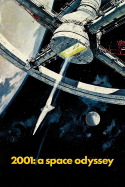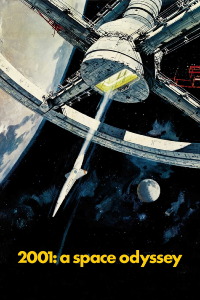
Review of 2001: A Space Odyssey (1968) by Shane M — 10 Apr 2014
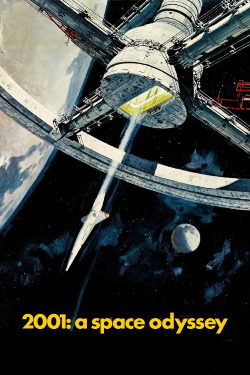
Stanley Kubrick's incredibly complex yet understandable sci-fi masterpiece. Based off Arthur C. Clarke's short story "The Sentinel", 2001: A Space Odyssey is split in four acts, the first focusing on the dawn of man, the second focusing on an astronaut that has secrets of an "epidemic" on Clavius Base, a lunar settlement on the Moon attempting to investigate a black monolith, the third being the Jupiter Mission, where two astronauts are traveling to Jupiter, when the sentient computer controlling the ship HAL 9000 takes full control and harms them, and the four following the remaining astronaut traveling "beyond the infinite" in a black monolith.
This film is hard to like due to the technique, concept, and complexity, but it remains one of the greatest films of all time for that reason, as well as an inspiring sci-fi masterwork. Kubrick uses his incredible genius in this tale of evolution, technology, artificial intelligence (A.
I.), extraterrestrial life, and leaps through time and space to craft a story that raises tons of questions, mainly, "Is A.I. dangerous? Is extraterrestrial life real? What did we evolve from? Are we over-reliant on technology? Is it becoming part of our life? Is it destroying us (the story takes place following a nuclear war, a recurring theme in Kubrick's productions)? Can we leap through time and space?" and, "Can we be reborn?" Kubrick and Clarke craft a script with tons of sci-fi elements and complexion, as well as intelligence, and a very small use of dialogue, new for a film at the time.
They also pioneer new techniques by using sound in place of traditional narrative techniques. Kubrick is able to capture his vision with incredible special effects, which won him his first and unfortunately, only Oscar, despite the fact he was nominated for so many, and is considered one of the best and most intelligent filmmakers of all time, despite being misunderstood at first, which doesn't explain the many nominations, but explains the win.
Kubrick also inputs lots of scientific accuracy in order to show his vision of space, and the ambiguous imagery help with the meaning of the film and its themes. Geoffrey Unsworth uses groundbreaking cinematography to bring this masterpiece to life, expertly shooting each scene with the right angle and range.
The soundtrack also remains iconic, which includes The Blue Danube by Johann Strauss II, and Also sprach Zarathustra by Richard Strauss, which help with the scene present in the music's presence. A sci-fi masterpiece, and the best of the genre.
A must-see for sci-fi and film fanatics.
This review of 2001: A Space Odyssey (1968) was written by Shane M on 10 Apr 2014.
2001: A Space Odyssey has generally received very positive reviews.
Was this review helpful?