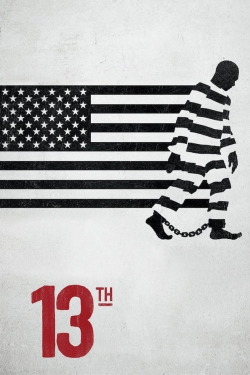
Review of 13th (2016) by Dolores H — 11 Oct 2017
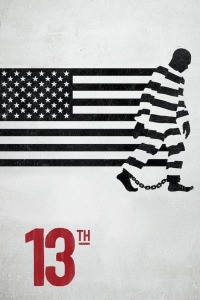
This is a chronicle of the criminalization of Black people in America. Through abhorrent and powerful narratives, director Ava DuVernay reveals how we have not moved past the time of slavery; its role has been subtly redesigned and persists in the seams of our institutions. Century after century, decade after decade, the dehumanization and violence against communities of color, particularly the Black community, has been traumatizing and blatantly disregarded by White America. "13th" shows how eerily familiar the past and present are. The film is not an easy or consoling watch. But, regardless, it sheds light on the generational transcendence of policies that continue to punish minorities in America.
The documentary has an all-star lineup of people who can intelligently discuss the subjects of mass incarceration and racialized violence; "13th" opening with Barack Obama, the first African American to become president of the United States, is in and of itself a powerful statement. Angela Davis's personal testimony is integral to the documentary's examination of the disturbing ways systems respond to dissent. As a prominent figure of the Civil Rights era who successfully defeated her indictment, Ms. Davis states, "[They] really meant to send me to the death chamber in order to make a point." Her story reveals the overt systematic pressure to subdue Black leaders by any means necessary. An interview of Davis on the notion of violence montaged with dialogue from the present forces the viewer to re-examine the human rights progress, if any, that the United States has had. Ava DuVernay employs Michelle Alexander to provide a keen insight on the expansion and function of the prison industrial complex. As an acclaimed civil rights lawyer and author of "The New Jim Crow: Mass Incarceration in the Age of Colorblindness," her voice is a powerful contribution to the survey of mass incarceration and racial caste in America. "13th" proves that Alexander's bold claim of mass incarceration being the new Jim Crow is not an overstatement. The documentary effectively balances its commentary by including opposing voices. When discussing the controversial control that the American Legislative Exchange Council (ALEC) has in creating policies, Michael Hough, a member of ALEC, claims it is "false that somehow ALEC [was in favor] of imprisoning a bunch of people." The director juxtaposes corresponding interview clips between Hough and Lisa Graves who is sharply combating his every claim. "ALEC pushed forward a number of policies to increase the number of people in prison and to increase the sentences of people who are in prison," refutes Graves. This make-shift debate portrays Michael Hough and ALEC as fraudulent and ignorant.
Through the juxtaposition of the past and present, the film surveys the intersection of race and violence. The back and forth frame between Donald Trump sympathizers shoving Black protesters and a mob of Jim Crow Era white supremacists assaulting a Black man slows the passage of time and erases the little progress we have made. Ava DuVernay intentionally shows the brutalized and disfigured corpse of Black fourteen-year old Emmett Till in her documentary; looking at this image for even a second is painful, but it epitomizes the terror and brutalization Black people experienced and continue to experience in America. The Emmett Till case is not new. Educators have repeatedly shown his case to no avail. DuVernay could have excluded this chapter of history; but, its inclusion did not feel redundant. Emmett Till continues to be relevant. "13th" includes several videos of Black civilians being murdered by cops-the very same people who have taken an oath to serve and protect are the ones pulling the trigger. Through these consecutive accounts, the film overwhelms viewers with White America's refusal to acknowledge the mass murder of Black people by police. "13th" exposes the dehumanization of black communities through footage of a cop callously replying, "Fuck your breath" to Eric Harris pleading, "I'm losing my breath" after being shot by an officer. Although these videos are unbearable to watch, they confirm the cruelty that Black people experience. Following these traumatic videos, the camera slowly pans across a wall filled with strips of tape denoting the unarmed black lives that have been lost to police violence alluding to something almost genocidal.
The film continues to explore the injustices toward Black people by examining how our very own political structures are complicit in devastating communities of color. Ava DuVernay introduces the case of Kalief Browder, a sixteen-year old Black boy imprisoned for a crime that he did not commit, to reveal how the prison and justice systems strip black and brown people of their rights and persistently pushes them into jails. Bryan Stevenson, professor of criminal law, explains that courts will punish people much harsher if they decide to take their case to trial by stating, "We have a criminal justice system that treats you better if you're rich and guilty than if you're poor and innocent," which compels viewers to question how our system operates. "13th" shows footage of Browder being assaulted by a Black policeman to underscore how, regardless of race or ethnicity, policing is brutal and its violence is a systemic issue. DuVernay unmasks the measures politicians take to deliberately harm people of color in America. Numerous bills and legislations were passed to unjustly incarcerate black and brown communities in mass; Michelle Alexander sheds light on the coerciveness and demoralization of our system by stating, "There are thousands of people in jail right this moment, that are sitting there for no other reason than they're too poor to get out,".
Although other films have conveyed the perpetuation of structural racism, none have come close to the aggressive and unembellished nature of DuVernay's work. "13th" transcends the boundaries of cinema by powerfully fitting one-hundred-fifty years of oppression from the plantation era to the present moment in one-hundred minutes. As the first documentary to ever open the New York Film Festival, the film's message continues to resonate today as a timely call to action. Ava DuVernay triumphs in birthing a provocative film that shocks people into reflecting upon their own anti-black sentiment and the ever-present racial injustices in America.
This review of 13th (2016) was written by Dolores H on 11 Oct 2017.
13th has generally received very positive reviews.
Was this review helpful?