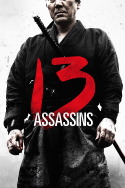
Review of 13 Assassins (2010) by Tyler J — 04 Jul 2012
Jûsan-nin no Shikaku (Takashi Miike, 2010).
Takashi Miike has long been one of Japan's most innovative, versatile, and original directors while still managing to be one of its most prolific at the same time. Despite this, he managed to labor in relative obscurity in his home country for almost a decade before exploding onto the international scene with Audition in 1999. He experienced a brief period of worldwide notoriety, releasing such smashes as Visitor Q, Ichi the Killer, and The Happiness of the Katakuris before slipping back into obscurity. Why this happened, the world will likely never know, but it was only a matter of time before they took notice again. Another decade later and Jûsan-nin no Shikaku, released in English-speaking countries as 13 Assassins, kicked off a second, and hopefully more enduring, wave of Miike-love in the west. 13 Assassins is a film from Miike's growing obsession with the historical-drama subgenre, in which he has quietly built up a reputation for releasing fantastic movies that never received the media coverage of his bigger, showier releases.
Plot: Lord Naritsugu (Saimin's Gorô Inagaki) is next in line for the Shogunate. No one, including the existing members of the Shogunate, want him to actually take a seat. So when a member dies and Lord Naritsugu begins his journey back from Edo, thirteen assasins are hired to stop him. The first half-and-change of the film is the assassins training to form a coherent unit, with us getting to know them, as well as Hanbei (Masachika Ichimura, who has since become a Miike regular), Naritsugu's personal bodyguard and the assassins' chief opposition, and Naritsugu himself. (Naritsugu is a bad guy. And I mean a bad guy, one so bad only Hanbei's honor stops him from deserting Naritsugu once he realizes what a morally bankrupt morass of evil this guy is.) Then comes the climactic battle, which most people characterize as the second half of the film. I timed it; it's actually forty-seven minutes. There's a coda afterwards that ties everything up in semi-satisfactory fashion (as long as you're at least passing familiar with certain aspects of Japanese mythology). But the second half of the movie is definitely focused on the forty-seven minutes of stunning choreography, brilliant atmosphere, and unrestrained violence of that final fight scene.
Miike's remake of a 1963 period piece (of the same name, directed by EÃ (R)chi Kudo) is faithful, from what I have read of the original, which is still somewhat hard to come by, but it also draws pretty heavily from Seven Samurai. At no point, however, can this be mistaken for anything but a Miike film, as is true with all of Miike's best work. And this certainly qualifies as some of Miike's best work; the first half is quiet and tense, the second absolute chaos, and they show a director with an ability to work just as easily in both while creating the proper atmosphere for each. Not an easy task. (Note how the lighting suddenly gets really, really gloomy, after a gradual fade throughout the film, as the assassins are preparing the ambush, for example.) There are those little touches of Miike wackiness, though some of them take, shall we say, a darker turn (the incident that causes the assassins to be hired, when its aftermath is finally depicted, is the hardest scene it's been to watch for me in a Miike film since the final fifteen minutes of Audition), there's the usual we're-not-QUITE-overacting-but-we're-really-enjoying-dancing-on-that-line, there's Miike's ever-honed sense of pace. In short, it's Takashi Miike. Short of someone who can't stomach violence, I can't imagine anyone not liking this, just as I can't imagine anyone not liking Sabu or Ley Lines or The Bird People in China. It's far too early to call this a classic, but I think when the chips shake out half a century from now, people will still be watching 13 Assassins. ****.
This review of 13 Assassins (2010) was written by Tyler J on 04 Jul 2012.
13 Assassins has generally received very positive reviews.
Was this review helpful?