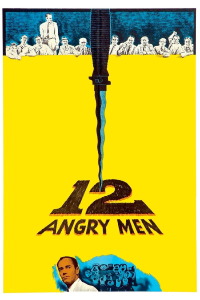
Review of 12 Angry Men (1957) by Cameron J — 22 Mar 2013
I tell you what, Henry Fonda sure did know how to get a room tensed up, because he couldn't even deal with grapes without them getting wrathful (Nyuk-nyuk-nyuk), so I guess I can understand why all of these people are so angry, even though I can't see what people are talking about when it comes to the rest of this film. This isn't like any kind of romantic comedy I've heard of, and it's certainly not all that Christmasy, but hey I still like it enough to where I have a bit of a hard time seeing why there are so many people who complain about this here "12 Grumpy Old Men" film. Oh no, wait, this is something else, and if you're getting angry about my jokes that center around me "mistakening" a film for another film, then be sure to check out this film in order to calm down, as you're not too likely to be as angry as these grumpy, not-so old men. I of course mean that these people weren't old at the time, except for Joseph Sweeney, of course, because by now, let me tell you, they're all... well, dead, but rest assured that they were old when their time came. Well, at least they lived a full life of stardom, and apparently a whole lot of knives, because even after he talked about knives to death in this film, Martin Balsam still went on to search for a knife-wielding murderer in "Psycho" and be in that one "Twilight Zone" episode where he went to a wax museum and found his wife killed by Jack the Ripper's wife the next morning. A lot of people figure that the irony in that episode Balsam's character's having to face the death of the his wife when he tried to save a wax Jack the Ripper statue from being tossed out with the rest of the museum he got it from, but no, the irony was the fact that Balsam just couldn't get away from those darn knives. Shoot, I doubt he minded, because when knives trailed him, you typically got a good film out of it, such as this little number, which, in all fairness, isn't without issues that may not make you angry, but will likely slow down momentum quite a bit.
A soley conversational dramatic thriller that thoroughly and realistically meditates upon exchanges more than atmosphere, this film could have slow, maybe even dull something fierce, and while I wasn't expecting this effort to be dull, I was expecting slowness, something that I didn't get as much of as I feared, but still got enough of for the film to sometimes lose me. I was never bored watching this film, finding myself much more often than not quite compelled, but there are still those moments in which a constant steady momentum either dips or is left sitting just long enough to bland up and disengage, and they're more frequent than they probably should be, because the film makes sure to leave plenty of room for slow spots. An extremely minimalist real-time character interaction piece that runs a relatively hefty 96 minutes, this film is generally tight in its finding padding material, yet there still come points where the film appears to be struggling to achieve its length, for although the film isn't quite as bloated as it could have been, there is a bit of material - particularly forcibly expository ones - that stands as not much more than fat around the edges that, after a while gets to be repetitious. This film is over an hour-and-a-half of mostly debating, and very little that's all that different from that, and no matter how compelling this is, you can only take so much of that formula before storytelling begins to run in circles that get to be a touch too hard to follow, though not so much so that repetition should make all that much of a difference in the long run. The consequential shortcomings behind this film are limited, so what has to be the final product's biggest issues are of a more natural persuasion, for although there is clearly enough juice to this film's story concept for it to be executed into the rewarding product that this film is, we're still talking about an extremely minimalist story that actively strips its characters of much development, and focuses on little details because broad happenings are incredibly rare, and you can deliver on only so much kick when dealing with a concept like that. Sure, when it's all said and done, most of about as much kick that can be delivered is delivered, thus the final product comes out as rewarding, but there is no denying the minimalism within this story concept, particularly when more consequential shortcomings begin to surface and further slow down momentum. Still, as both naturally and consequentially flawed as the film is, it has enough to it for it to compel consistently and ultimately rewarding, and rest assured that there is evidence to support this ruling.
Even for 1957, there really isn't a whole lot to commend about this film's visual style, but the trained eye will find it hard to deny the impressiveness within Boris Kaufman's cinematography, which isn't too upstanding, but has a certain grit to its lighting that reflects the bit to this film's atmosphere, while tight plays with scope get you reasonably intimate with our leads' claustrophobic environment. Like I said, it requires a bit of focus to notice the strengths in this film's photography, and even then, after a while, you're bound to get a little too used to Kaufman's tastes, yet you'll find that once you've locked into the strengths within this film's visual style, you can never fully ignore the fact that photographic sharpness does play a part in the reinforcing of the intrigue within this film's subject matter, which does indeed boast quite a bit of potential for intrigue deliverance. As I said, this film's story concept is perhaps too minimalist for its own good, so it's not like this thriller was ever to be too thrilling, but immediate intrigue is sparked by the undeniable uniqeuness of this film's concept of being a real-time conversational courtroom drama, and finds itself augmented by this story's being all but rich with the potential for subtle, but impacting depth that plenty of films of this time weren't gutsy enough to explore. This film, however, has enough gets to take the plunge and milk its story for all its worth, and while there's not too much milk to this meal, Reginald Rose's script is still worthwhile enough to fulfill about as much potential as it can, delivering on decent dialogue to keep things lively, while structuring the debates around which this film's plot is pretty much entirely centered with a generally cleverness that comfortably and comprehensively unravels the mechanics behind a seemingly open-shut case in a fashion that keeps you gripped, wondering just how in the world things are going to be further explained. This film's conflict is paper-thin, but Rose fleshes out just enough for it to earn your investment, especially when spiced up by realized characterization and thematic depth that director Sidney Lumet further plays with as storyteller in order draw a bit of human tension that in turn recieves additional breathes of life from inspired onscreen performances. There is, of course, not too much material for our performers to play with, yet just about every member of this 12-man cast delivers on distinquished and memorable portrayals, with Lee J. Cobb all but stealing the show by being commanding and sometimes even emotionally layered as stubborn "antagonist", while Martin Balsam engages as the jurors' foreman, John Fiedler initially charms as a soft-spoken meek whose eventually finding his voice is sold by Fiedler's confident presence play, E.G. Marshall engages as a steadfast analyzer, Jack Klugman feels assured as a particularly average Man whose slight distinctions make quite a bit of difference in his character in the long run, Edward Binns grips as a well-restrained tough guy, Jack Warden grabs your attention as an indifferent Joe whose views steadily grow firmer, Joseph Sweeney intruges as a wisely thorough old observer, Ed Begley feels humanly balanced as a loudmouth bigot, George Voskovec humanly convinces as a moral foreigner, Robert Webber proves to be enjoyable as a wisecracker, and main leading man Henry Fonda convincing as the initial odd man out who both faces plenty of hard evidence against him and holds a strong belief that anything is possible. So yeah, as that monotonous listing will tell you, there are plenty of talented performers in this cast, and they all deliver, with enough strong chemistry and individual charisma to help greatly in defining the humanity that helps greatly in defining this film, which isn't without its problems, but is still backed by enough inspired performances, both on and off of the screen, to sustain your investment through and through.
To reach a verdict, this film isn't without its slow spells, which aren't helped by this film's rather reptitious padding of a relatively thin story concept whose natural shortcomings present the final product with way too many challenges, most of which are fulfilled enough for the final product to reward on the whole, delivering on clever photography that compliments the depths within this naturally flawed story concept, which is still with enough juice and thematic depth - drawn by inspired writing and direction, and carried by across-the-board memorable performances by an esteemed cast of convincing charismas - to make Sidney Lumet "12 Angry Men" a mostly entertaining and often rather gripping conversational thriller that overcomes its many shortcomings just enough to reward on the whole.
3/5 - Good.
This review of 12 Angry Men (1957) was written by Cameron J on 22 Mar 2013.
12 Angry Men has generally received very positive reviews.
Was this review helpful?